
Best Vegan Skincare for Eczema: 2026 Guide
by Ian Gabbidon on Sep 27, 2026

Table of Contents
- What Makes Vegan Skincare for Eczema Different
- Quick Comparison: Best Vegan Skincare for Eczema
- How to Treat Itchy Skin with Vegan Formulas
- Skincare Ingredients to Avoid with Eczema
- Natural Ingredients for Eczema Relief
- Product Reviews: Iuvo Skincare for Eczema-Prone Skin
- Cost Per Use: Vegan Skincare Value for Eczema
- Seasonal Routine Adjustments for Eczema-Prone Skin
- Winter adjustments:
- Summer adjustments:
- Transition months (spring and autumn):
- Frequently Asked Questions
Last Updated: September 27, 2026
What Makes Vegan Skincare for Eczema Different
Vegan skincare for eczema avoids all animal-derived ingredients while prioritising formulas that calm inflammation and rebuild the skin barrier. This guide from Iuvo Skincare covers what actually works, what to avoid, and how to build a routine that respects reactive skin.
The distinction matters more than most people realise. A product can be plant-based and still contain essential oils, alcohol, or synthetic fragrance that trigger a flare-up. Vegan certification tells you nothing about whether a formula is gentle enough for compromised skin.
What separates truly effective vegan skincare for eczema is the combination of two things: no animal derivatives and no common irritants. The best options pair humectants like glycerin with occlusives and emollients such as jojoba, rosehip, and shea to reduce transepidermal water loss.
According to National Eczema Society guidance on emollients, consistent moisturising remains the foundation of eczema management, regardless of whether a product is vegan.
That explains the theory. Here's where most "natural" brands fall short.
Quick Comparison: Best Vegan Skincare for Eczema
The table below summarises the Iuvo Skincare range by function, price, and key ingredients for eczema-prone skin.
| Product | Price | Size | Best For | Key Ingredients |
|---|---|---|---|---|
| Soothing Unscented Face & Body Soaps | £4.00 | 80g | Daily cleansing, flare-up weeks | No essential oils |
| Deep Hydrating Unscented Face & Body Butters | £9.00 | 100g | Natural, gentle moisturising and hydrating | Coconut, jojoba, rosehip, neem |
| Rosehip, Grapeseed & Jojoba Face & Body Oil | £24.00 | 100ml | Deeply hydrating and rejuvenating | Grapeseed, jojoba, rosehip |
| Rosehip, Grapeseed & Jojoba Face & Body Oil | £9.00 | 30ml | Deeply hydrating and rejuvenating | Grapeseed, jojoba, rosehip |
| Sensitive Face Wash | £8.00 | 150ml | Soothing and calming sensitive skin, removing debris and purifying | Rose geranium |
| Gentle Facial Cleansing Lotion | FACE | Linden Blossom | £8.00 | 150ml |
Every item is 100% vegan certified, handmade in the UK, and free from parabens, sulphates, and palm oil.

How to Treat Itchy Skin with Vegan Formulas
Treating itchy skin starts with removing the trigger, then replacing what the barrier has lost. Scratching damages the lipid barrier further, which increases water loss and lets irritants in more easily.
A practical sequence looks like this:
- Cleanse with lukewarm water and an unscented, sulphate-free wash
- Pat dry within 60 seconds, leaving skin slightly damp
- Apply a humectant-rich layer while the skin is still moist
- Seal with an emollient butter or oil to slow water loss
- Reapply through the day whenever tightness returns
The timing matters as much as the product. Applying moisturiser within three minutes of bathing traps far more hydration than waiting until the skin is fully dry.
NHS advice on atopic eczema treatment recommends emollients applied frequently, even on clear skin, to reduce flare frequency.
What most guides miss is that itch relief is not the same as hydration. A product can feel soothing for ten minutes and still leave the barrier weaker by evening if it contains drying alcohols.
Skincare Ingredients to Avoid with Eczema
Skincare ingredients to avoid with eczema fall into two groups: those that strip the skin barrier, and those that provoke an immune response. Understanding which is which helps you read a label rather than memorise a list.
Barrier-stripping ingredients remove the lipids that hold water in. The most common are:
- Sodium lauryl sulphate (SLS) and sodium laureth sulphate (SLES): anionic surfactants that bind to skin lipids and carry them away with water. SLS is the more aggressive of the two; SLES is milder but still a problem for compromised skin.
- Alcohol denat (denatured alcohol): evaporates quickly and takes moisture with it, leaving a tight, stinging sensation that signals barrier disruption.
- Soap-based cleansers with a high pH: healthy skin sits at roughly pH 4.5-5.5. Traditional soap pushes pH above 9, which activates enzymes that break down the lipid barrier.
Immune-provoking ingredients trigger allergic contact dermatitis in people whose skin is already reactive:
- Fragrance and parfum: the single most common contact allergen in cosmetics. Under UK and EU cosmetic labelling rules, 26 specific fragrance allergens must be declared individually when they exceed set thresholds, but the umbrella term "parfum" can still hide a complex mixture.
- Essential oils: lavender, citrus, eucalyptus, tea tree, and rose geranium are all common sensitisers. "Natural" does not mean hypoallergenic; linalool and limonene, both found in many essential oils, are themselves declared allergens.
- Methylisothiazolinone (MI) and methylchloroisothiazolinone (MCI): preservatives that are among the most frequent causes of cosmetic contact allergy. MI was restricted in leave-on products following a sharp rise in reported reactions.
- Cocamidopropyl betaine: a mild surfactant that is nonetheless a recognised allergen, often present in "gentle" washes.
- Propylene glycol: a humectant that some eczema sufferers react to, despite being widely used in sensitive-skin formulas.
Palm oil derivatives are a separate concern. They are rarely an irritant, but many vegan buyers avoid them on ethical grounds, and they appear under dozens of INCI names, palmitate, stearate, cetyl alcohol, and polysorbates among them.
This is why unscented formulas matter. Removing fragrance entirely removes the most frequent trigger in one step, and it is the single change most likely to reduce flare frequency for someone who has not yet identified their trigger.
Natural Ingredients for Eczema Relief
Natural ingredients for eczema relief work best when they support the skin's own repair process rather than masking symptoms. To understand why, it helps to know what the skin barrier actually is.
The outermost layer of skin, the stratum corneum, is often described as a brick wall. The "bricks" are corneocytes (flattened skin cells), and the "mortar" is a lipid matrix made up of ceramides, cholesterol, and free fatty acids. In eczema-prone skin, this mortar is deficient. Ceramide levels are typically lower, which means water escapes more easily and irritants get in more readily. That is the mechanism behind the dryness, the itch, and the reactivity.
Effective emollients work by topping up that mortar. They fall into three functional categories:
- Humectants (glycerin, hyaluronic acid, urea) draw water into the skin from the air and from deeper layers.
- Emollients (jojoba, rosehip, grapeseed, shea) soften and smooth by filling the gaps between corneocytes.
- Occlusives (shea butter, coconut oil, waxes) form a physical film that slows water loss.
Most single-ingredient products do one job. The best formulas combine all three.

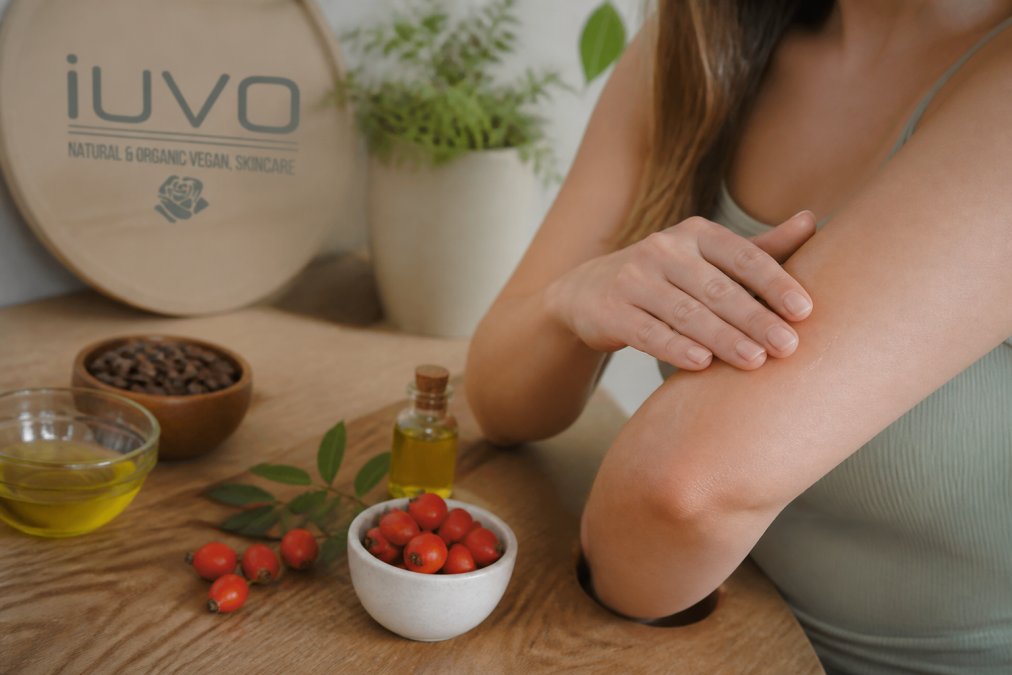
Jojoba oil is the standout carrier oil. Its structure is a liquid wax ester, not a triglyceride, which makes it closely resemble human sebum. That means it absorbs without clogging pores and helps regulate oil production rather than simply coating the skin.
Rosehip oil brings linoleic and linolenic acids, both components of the barrier's lipid matrix, plus vitamins A and C, which support skin regeneration and can improve the appearance of scarring left by repeated scratching.
Grapeseed oil is high in linoleic acid and low in oleic acid, which makes it light and easily absorbed. Oils high in oleic acid (olive, coconut) can feel heavier and, in some people, disrupt the barrier further.
Shea butter is rich in stearic and oleic acids and acts as an occlusive, sealing in the humectants and emollients applied beneath it.
Coconut oil soothes and has mild antibacterial properties, but its high oleic acid content means it works better as an occlusive layer than as a primary emollient for very reactive skin.
Neem oil assists with pain relief and has traditional use in calming irritated skin, though its strong nutty smell takes getting used to.
Ceramides are worth seeking out as an added ingredient. They are the same molecules the barrier is built from, and topical ceramides have been shown to improve barrier function in dry and eczema-prone skin.
British Association of Dermatologists patient information on eczema notes that emollients combining humectants and occlusives outperform single-ingredient products.
Product Reviews: Iuvo Skincare for Eczema-Prone Skin
Iuvo Skincare is a family-run, triple award-winning brand whose entire range is 100% vegan certified, cruelty-free, and free from nuts, palm oil, SLS, sulphates, and parabens. Everything is handmade in the UK.
For eczema-prone skin, the range is built around one principle: remove what irritates, keep what repairs. That means no essential oils in the unscented lines and no synthetic additives anywhere.
Soothing Unscented Face & Body Soaps
At £4.00 for 80g, this is the most affordable entry point and the one to reach for during a flare-up. There are no essential oils, no fragrance, and no sulphates. It is formulated for sensitive, eczema, and psoriasis-prone skin and works on both face and body.
The honest limitation: an unscented bar cleanses gently but does nothing for hydration on its own. Pair it with the butter or oil immediately after.
Deep Hydrating Unscented Face & Body Butters
The £9.00 butter is the workhorse of an eczema routine. Coconut oil soothes, jojoba oil helps prevent itching, rosehip oil supports scarring, and neem oil assists with pain relief. It is unscented and suitable for face and body.
The neem oil in this product has a strong nutty smell.

Rosehip, Grapeseed & Jojoba Face & Body Oil
The 100ml oil costs £24.00 and the 30ml travel size costs £9.00. Grapeseed oil is light and easily absorbed, jojoba oil provides balanced hydration without clogging pores, and rosehip oil promotes regeneration and improves texture.
This is the best pick for full-body use after a bath, and it doubles as a massage oil. The 30ml size is the sensible way to test tolerance before buying the full bottle.
Cost Per Use: Vegan Skincare Value for Eczema
Cost per use matters more than sticker price for eczema skincare, because the routine only works if you can afford to apply it generously and often.
Here is how the Iuvo range breaks down over a typical eight-week cycle:
| Product | Price | Estimated Uses | Cost Per Use |
|---|---|---|---|
| Unscented Soap (80g) | £4.00 | ~60 washes | £0.07 |
| Unscented Butter (100g) | £9.00 | ~90 applications | £0.10 |
| Body Oil 30ml | £9.00 | ~30 applications | £0.30 |
| Body Oil 100ml | £24.00 | ~100 applications | £0.24 |
| Sensitive Face Wash (150ml) | £8.00 | ~75 washes | £0.11 |
A complete starter routine (soap, butter, 30ml oil) comes to £22.00.
Seasonal Routine Adjustments for Eczema-Prone Skin
Eczema routines need to change with the seasons. The same butter that rescues skin in January can feel heavy and occlusive in July, and the same lightweight oil that works in summer leaves skin tight in winter.
Winter adjustments:
- Apply within three minutes of a lukewarm shower, never a hot one
- Add a mid-day reapplication on hands and forearms
Summer adjustments:
- Rinse off sweat promptly; salt residue aggravates itch
- Switch to the unscented soap for a gentler cleanse after sun exposure
Transition months (spring and autumn):
- Reduce cleansing frequency if the barrier is already stressed
The principle is simple: heavier in cold, drier air; lighter in warm, humid air. React to the skin, not the calendar.
Frequently Asked Questions
Is vegan skincare better for eczema?
Vegan skincare avoids animal-derived ingredients, but the real benefit for eczema comes from what it leaves out: fragrances, parabens, sulphates, and other irritants. Plant-based formulas rich in emollients like jojoba and rosehip can support the skin barrier. Look for vegan products that are also fragrance-free and hypoallergenic to reduce flare-up risk.
Which natural ingredients help soothe eczema?
Jojoba oil, rosehip oil, coconut oil, and grapeseed oil are well-known for their soothing and hydrating properties. Ceramides and humectants like glycerin also help repair the lipid barrier. Neem oil may assist with pain relief, though it has a strong scent. Always patch test new ingredients on a small area first.
Are there any common skincare ingredients to avoid if you have eczema?
Yes. Avoid fragrances (both synthetic and essential oils), parabens, sulphates (like SLS), alcohol, and synthetic additives. These can strip the skin barrier and trigger inflammation. Also steer clear of products with harsh exfoliants or high concentrations of essential oils, which may cause irritation on eczema-prone skin.
How do I know if a skincare product is truly vegan and cruelty-free?
Look for third-party certifications such as the Vegan Society trademark or Leaping Bunny. These logos confirm no animal testing or animal-derived ingredients. Reputable brands list certifications on their website or packaging. Be wary of vague claims like 'natural' without proof. Iuvo Skincare, for example, is Vegan certified and cruelty-free.
Can plant-based moisturisers effectively treat eczema flare-ups?
Plant-based moisturisers can be effective if they contain barrier-repairing ingredients like ceramides, jojoba oil, or shea butter. They help reduce transepidermal water loss and calm irritation. However, they are not a cure for eczema. Use them as part of a gentle routine and consult a doctor if flare-ups persist or worsen.
Managing eczema is a long game, and the products you choose either support the barrier or work against it. Iuvo Skincare makes that decision easier with a 100% vegan certified range that is handmade in the UK and free from the additives most likely to trigger a flare. The unscented soaps, deep hydrating butters, and rosehip, grapeseed and jojoba oils are formulated for exactly this kind of reactive skin. Search our store to build a routine that soothes rather than irritates.


