
Why Avoid Palm Oil in Skincare: A 2026 Guide
by Ian Gabbidon on Sep 23, 2026

Table of Contents
- Why Avoid Palm Oil in Skincare: The Core Reasons
- Is Palm Oil Safe for Skin? What the Chemistry Says
- Hidden Names for Palm Oil in Cosmetics: How to Read an INCI List
- How to Verify Vegan Beauty Certification (Without Greenwashing)
- RSPO Certification: Why Sustainable Palm Oil Is More Complicated Than It Sounds
- Chemical Alternatives to Palm-Derived Surfactants and Emollients
- Palm Oil Free Skincare Brands: What to Look For
- Frequently Asked Questions
Last Updated: September 23, 2026
Why Avoid Palm Oil in Skincare: The Core Reasons
Palm oil is the most widely used vegetable oil on the planet, and it appears in roughly half of all supermarket products, from biscuits to body lotion. For skincare specifically, the case for avoiding it rests on three pillars: tropical deforestation, greenhouse gas emissions from drained peatlands, and the loss of biodiversity in some of the world's richest ecosystems. At Iuvo Skincare, we removed palm oil from every formula for exactly these reasons. Below, we break down what the environmental data actually shows, how to spot palm-derived ingredients hiding behind unfamiliar names, and which alternatives genuinely work.
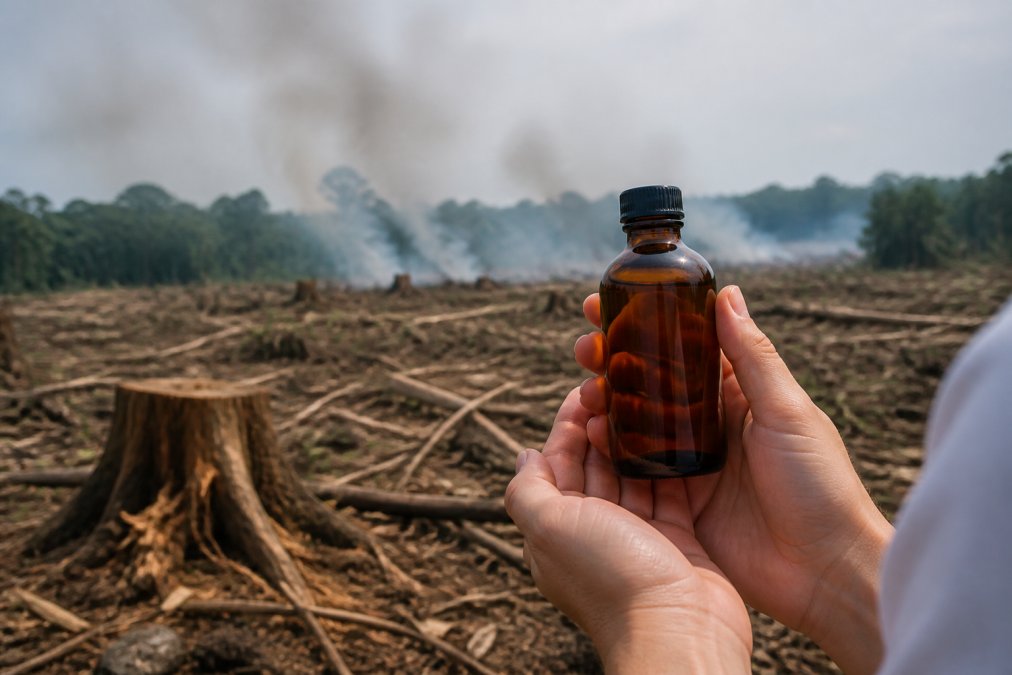
The problem is not palm oil's chemistry. It is where and how it is grown. Palm oil itself is an efficient crop, producing more oil per hectare than soy, rapeseed or sunflower. That efficiency is precisely why demand has grown so quickly, and why the expansion has come at such a cost.
Deforestation, Peatland Drainage and Carbon Emissions
Palm oil plantations expand into tropical forest, and in Southeast Asia that expansion has frequently occurred on peatlands. Peat is partially decomposed plant material that has accumulated over thousands of years; when drained to make way for plantations, it decomposes and releases stored carbon. Drained peat also burns easily, and peat fires produce dense smoke and significant carbon emissions. According to the UN Environment Programme's work on peatlands and climate, protecting and restoring peatlands is one of the most cost-effective climate interventions available. For a skincare buyer, the practical takeaway is simple: the carbon footprint of a palm-derived ingredient is often far higher than its plant-based origin suggests.
Biodiversity Loss and the Orangutan Connection
Deforestation destroys habitat, and few species illustrate the consequence more sharply than the orangutan. The orangutan is found only on the islands of Sumatra and Borneo, and its populations have declined sharply as forest has been converted to plantation. Habitat destruction also affects countless other species, from gibbons to hornbills to forest-dwelling insects that pollinate and disperse seed. Biodiversity loss of this kind is not reversible on a human timescale. Once a forest is cleared, the species that depended on it do not simply relocate.
Is Palm Oil Safe for Skin? What the Chemistry Says
Palm oil is not toxic, and no credible regulator treats it as a hazard in cosmetics. The useful question is narrower: what does it actually do on skin, and does that suit your skin type? Answering that means looking at three things, fatty acid profile, comedogenicity, and what refining does to the ingredient.
Fatty acid profile. Palm oil is roughly balanced between saturated and unsaturated fat, with palmitic acid (a saturated fatty acid, typically the largest single component) and oleic acid (monounsaturated) as the main players. Palmitic acid also occurs naturally in human sebum, which is why it is often described as 'skin-identical'. That framing is partly marketing: sebum contains palmitic acid, but sebum composition varies enormously between people, and adding more of one fatty acid does not automatically improve the skin's own barrier.
Comedogenicity. The comedogenic scale (0-5) is a rough in-vitro guide, not a clinical prediction. Palm oil and palm-derived emollients such as isopropyl palmitate and ethylhexyl palmitate are commonly rated around 3-4 on that scale, meaning they can contribute to congestion in acne-prone skin. Ratings are contested and depend on concentration and the rest of the formula, so treat them as a signal rather than a verdict. If you are prone to breakouts, the practical move is to check whether a palm-derived ester sits high in the INCI list, the higher it appears, the greater its share of the formula.
Refining. Cosmetic-grade palm oil is usually refined, bleached and deodorised (RBD). That process removes free fatty acids, odour compounds and much of the natural colour, producing a stable, cheap, near-odourless base. The trade-off is that heat and processing can generate glycidyl esters and 3-MCPD esters, which are process contaminants rather than ingredients. In the EU these are regulated in refined oils, and UK manufacturers are expected to meet equivalent safety standards. Levels in finished cosmetics are generally low, but the point stands: 'plant-derived' does not mean 'unprocessed'.
Where palm derivatives actually sit in a formula. In a typical moisturiser, palm-derived ingredients do the unglamorous work: cetearyl alcohol and glyceryl stearate hold the oil and water phases together, stearic acid gives body and a dry-touch finish, and sodium lauryl sulphate or sodium laureth sulphate do the foaming in a cleanser. None of these are inherently bad. The issue for sensitive skin is that SLS in particular is a known irritant at higher concentrations, and it is a palm-derived surfactant in most mass-market washes.
The honest summary. For most people, palm oil in skincare is not a safety problem, it is a formulation choice with environmental baggage. For acne-prone or eczema-prone skin, the more useful filter is the surfactant and emollient system as a whole, not the palm origin alone. A fragrance-free, low-surfactant formula built on shea, jojoba or olive-derived emulsifiers will usually suit reactive skin better than a palm-based one, regardless of where the palm came from.
Hidden Names for Palm Oil in Cosmetics: How to Read an INCI List
Palm oil rarely appears on an ingredient list as "palm oil." It appears as a derivative, and there are dozens of them. Learning to read an INCI list is the single most useful skill for anyone who wants to avoid palm oil in skincare. The INCI system is the international naming standard for cosmetic ingredients, and it is the same on a label in any market, which makes it reliable once you know what to look for.
Common palm-derived ingredients include:
- Sodium lauryl sulphate (SLS) and sodium laureth sulphate (SLES) - surfactants and cleansing agents
- Cetearyl alcohol and cetyl alcohol - emulsifiers and thickeners (fatty alcohols, not drying alcohols)
- Palmitic acid and stearic acid - emollients and texture agents
- Glyceryl stearate - an emulsifier
- Elaeis guineensis - the botanical name for the oil palm itself
- Sodium palmate and sodium palm kernelate - soap bases
- Palm kernel oil derivatives, often listed under fatty acid names
There is no shortcut here. A derivative can come from palm, coconut or a synthetic route, and the label alone will not tell you which. That ambiguity is one of the strongest arguments for brands that simply do not use palm-derived ingredients at all.
How to Verify Vegan Beauty Certification (Without Greenwashing)
Vegan beauty certification is verifiable, but only if you know which marks actually mean something. A "vegan" claim on a bottle is a marketing statement; a certification from a recognised body is a claim someone has audited. The two are not the same, and the gap between them is where greenwashing lives.
Here is a practical checklist for verifying a vegan claim:
- Look for a named certification body, not just the word "vegan"
- Check that the certification covers the finished product, not only the raw ingredients
- Confirm the brand states it is cruelty-free separately, since vegan and cruelty-free are different claims
- Search the certification body's own register for the brand name
- Treat "plant-based" and "natural" as unrelated to vegan status
The distinction matters because a product can be vegan and still tested on animals, or cruelty-free and still contain animal-derived ingredients. Iuvo Skincare holds vegan certification across its range, which means the claim is auditable rather than self-declared.
RSPO Certification: Why Sustainable Palm Oil Is More Complicated Than It Sounds
The Roundtable on Sustainable Palm Oil (RSPO) is the main certification scheme for sustainable palm oil, and it is more complicated than the logo suggests. RSPO certification operates across several supply chain models, and they are not equivalent in what they guarantee.
Soothing Unscented Face & Body Soaps →
The main models are:
- Identity Preserved - the oil is kept separate from planting to final product, offering the strongest traceability
- Segregated - certified oil is kept separate from non-certified oil along the supply chain
- Mass Balance - certified and non-certified oil are mixed, with the certified volume tracked administratively
- Book and Claim - the buyer purchases certificates rather than physical certified oil
The practical consequence is that a product carrying an RSPO logo may contain no physically certified palm oil at all. That does not make the scheme worthless, but it does mean supply chain transparency depends on which model a brand uses. A brand that tells you its model is being more honest than one that simply displays a logo. For buyers who want certainty, palm oil free is a simpler position to verify than any certification tier.
Chemical Alternatives to Palm-Derived Surfactants and Emollients
Most articles stop at 'use coconut instead'. That advice is incomplete, because the replacement has to match the function, the pH, and the skin type, and because 'palm-free' is far harder to verify than the label suggests. This section covers both: what actually works as a substitute, and why tracing palm derivatives through a supply chain is genuinely difficult.
Matching the substitute to the function
| Function | Common Palm-Derived Ingredient | Credible Alternative | Trade-off to know |
|---|---|---|---|
| Anionic surfactant / cleanser | Sodium lauryl sulphate (SLS), sodium laureth sulphate (SLES) | Coco-glucoside, decyl glucoside, sodium cocoyl isethionate | Glucosides foam less and feel less 'squeaky clean'; some users find them gentler, others find them filmy |
| Non-ionic surfactant / emulsifier | Glyceryl stearate, cetearyl alcohol | Cetearyl olivate (olive-derived), sorbitan olivate, cetearyl glucoside | Olive-derived emulsifiers can feel heavier and are more expensive per kilo |
| Emollient | Palmitic acid, isopropyl palmitate | Shea butter, cocoa butter, jojoba oil, squalane (olive- or sugarcane-derived) | Butters are occlusive and can feel greasy; squalane is lighter but costlier |
| Soap base | Sodium palmate, sodium palm kernelate | Olive oil castile soap, coconut oil soap | Coconut soap is cleansing but can be drying; castile is milder but softer |
| Thickener / structure | Stearic acid | Candelilla wax, shea butter, cetyl alcohol from non-palm sources | Waxes can leave a waxy residue; non-palm cetyl alcohol is harder to source at scale |
Two practical notes. First, coconut-derived surfactants are not automatically gentler, sodium coco-sulphate is still a sulphate, and some people react to coconut derivatives as readily as to palm ones. Second, glucosides (coco-glucoside, decyl glucoside) are the most common palm-free surfactant swap in 'gentle' cleansers, but they perform best at a slightly acidic pH and can be harder to preserve, which is why they appear more often in smaller-batch and handmade ranges than in mass-market washes.
Why 'palm-free' is legally and practically complex
A 'palm oil free' claim sounds binary. In practice it is not, for three reasons.
1. Derivatives are chemically indistinguishable from their source. Once palm oil is hydrolysed into fatty acids and re-esterified into, say, glyceryl stearate, the molecule is identical to the same ingredient made from rapeseed or sunflower. There is no analytical test that reliably tells a formulator, let alone a consumer, which feedstock was used. Traceability therefore depends on documentation, not chemistry.
2. Supply chains are pooled. Oleochemicals are traded as commodities. A single drum of stearic acid may contain material from multiple refineries, and those refineries may process palm, coconut, tallow and rapeseed on the same lines. This is the same pooling problem that makes RSPO's Mass Balance model possible, certified and non-certified volumes are mixed, with the certified share tracked administratively rather than physically.
3. 'Palm-free' has no single legal definition in the UK. There is no statutory threshold for the claim. A brand can reasonably mean 'no palm oil as a listed ingredient', 'no palm-derived ingredients at all', or 'no palm in the finished formula but palm-derived processing aids used upstream'. The claim is governed by general consumer protection rules, it must not be misleading, but the burden of interpretation falls on the buyer. That is why the most useful brands state their position explicitly rather than relying on the phrase alone.
What to ask a brand instead of 'is it palm-free?'
- Which specific ingredients are you excluding, palm oil only, or all palm-derived oleochemicals?
- Do you publish full INCI lists online, not just on the pack?
- If you use RSPO-certified material, which supply chain model, Identity Preserved, Segregated, Mass Balance or Book and Claim?
- Are your surfactants and emulsifiers from a named non-palm feedstock, or simply 'plant-derived'?
Palm Oil Free Skincare Brands: What to Look For
Palm oil free skincare brands are not all equally transparent, so the label claim alone is not enough. What separates a genuine palm-free brand from a marketing one comes down to disclosure and consistency.
Look for these signals:
- A clear statement that the brand is palm oil free, not merely "palm oil free in some products"
- Full ingredient lists published online, not just on the packaging
- Named certifications for vegan and cruelty-free status
- A stated position on palm derivatives, not just palm oil itself
- Willingness to explain why the brand made the choice
Iuvo Skincare is a family-run, handmade range that is free from palm oil, SLS, sulphates and parabens, and carries vegan certification. The Vegan Society's guidance on vegan certification explains how independent certification differs from self-declared claims, which is a useful benchmark when comparing brands. Our Soothing Unscented Face & Body Soaps are formulated without essential oils for sensitive, eczema and psoriasis-prone skin, and the Nourish Award Winning Deep Hydrating Unscented Face & Body Butters use coconut, jojoba, rosehip and neem oils as the emollient base instead of palm derivatives. For anyone building a full routine, the Unscented Antiperspirant Deodorant and the Hair & Scalp Oil round out a palm-free approach from head to toe.


The challenge with avoiding palm oil is that it hides behind dozens of derivative names, and even certified supply chains do not guarantee what is physically in the bottle. The simplest way to be certain is to buy from a brand that has removed palm-derived ingredients entirely and can show you the full list. Iuvo Skincare is a triple award-winning, vegan certified, family-run range made without palm oil, SLS, sulphates or parabens, with unscented options built for sensitive and eczema-prone skin. Search our store to find a palm-free routine that suits you.
Frequently Asked Questions
Is palm oil safe in skincare?
Palm oil itself is not inherently toxic. It is used as an emollient, surfactant and emulsifier. The concern is not safety on skin but the environmental damage linked to its production and the difficulty of verifying sustainable sourcing. For sensitive skin, the bigger issue is often the other ingredients in the same formulation. If you want to avoid palm oil entirely, check for derivatives like palmitic acid and lauric acid on the label.
How can I identify palm oil derivatives on ingredient labels?
Look for hidden names for palm oil in cosmetics such as palmitic acid, sodium lauryl sulphate, sodium laureth sulphate, cetearyl alcohol and glyceryl stearate. These are all palm-derived. Because INCI lists do not state the source, you often need to contact the brand directly. A palm oil free skincare brand should be able to confirm its supply chain transparency without hesitation.
What are the disadvantages of palm oil on skin?
Palm oil is not a known skin irritant for most people, but its derivatives can be comedogenic for some. The main disadvantage is ethical and environmental: deforestation, peatland drainage and habitat destruction for orangutans. For those with eczema or psoriasis, the concern is more about the overall formulation than palm oil alone. Choosing a palm oil free skincare brand removes that uncertainty.
Is palm oil banned in the UK?
No, palm oil is not banned in the UK. It is widely used in food and cosmetics. The UK supports the Roundtable on Sustainable Palm Oil (RSPO) certification, but this is voluntary. There is no legal requirement for brands to declare palm oil derivatives on labels. That is why reading INCI lists and asking brands directly is the only reliable way to avoid it.


