
Best Skincare for Eczema-Prone Skin: 2026 Guide
by Ian Gabbidon on Oct 14, 2026

Table of Contents
- What Actually Matters in Skincare for Eczema-Prone Skin
- Quick Comparison: Eczema-Friendly Products and Prices
- The Best Face Wash for Eczema: Gentle, Non-Soap Cleansers
- The Best Moisturiser for Eczema-Prone Skin: Butters, Creams and Oils
- An Eczema Skincare Routine for Morning and Evening
- What Not to Put on Eczema Skin: Ingredients to Avoid
- Matching Products to Severity, Body Area and Skin Type
- When Skincare Is Not Enough: Seeking Medical Care
- Building Your Eczema Skincare Routine: What to Buy First
- Frequently Asked Questions
Last Updated: October 13, 2026
What Actually Matters in Skincare for Eczema-Prone Skin
Finding the best skincare for eczema prone skin is less about chasing new ingredients and more about removing the ones that trigger flare-ups. Eczema, or atopic dermatitis, is a condition where the skin barrier is impaired, so moisture escapes and irritants get in more easily. That fact should shape every product you buy.
This guide from Iuvo Skincare covers what to look for, what to avoid, and how to build a routine that calms rather than aggravates. Below, we break down the products we would choose, why they work, and how to use them in the right order. The guidance here follows the same principles the National Eczema Society sets out for daily care.
If you have ever bought a "natural" cream that still made your skin sting, you are not alone. The problem is usually fragrance, essential oils in high concentrations, or harsh foaming agents, not the word "natural" itself. Most guides list products without explaining the selection criteria; we will show you exactly how to judge any product, including ours.
How We Selected These Products
We judged every product against four criteria: a non-soap cleansing base, fragrance-free or low-fragrance formulation, barrier-supporting oils and butters, and honest value for the size you get. Products relying on sulphates, synthetic fragrance or drying alcohols did not make the list.
Our picks are handmade in small batches, free from parabens, sulphates and palm oil, and vegan certified and cruelty-free.
We have kept the range deliberately small: a short routine you actually stick to beats a shelf full of products you use twice.
Quick Comparison: Eczema-Friendly Products and Prices
| Product | Price | Best For |
|---|---|---|
| Soothing Unscented Face & Body Soaps | £4.00 | Full-body washing, all severities |
| Gentle Facial Cleansing Lotion | £8.00 | Dry, tight facial skin |
| Sensitive Face Wash | £8.00 | Oily or combination sensitive skin |
| Deep Hydrating Unscented Face & Body Butters | £9.00 | Very dry skin, itching |
| Nourishing Day & Night Cream | £34.00 | Daily facial moisturising |
| Butter Cream with Scoop | £20.00 | Facial hydration on a budget |
| Rosehip, Grapeseed & Jojoba Face & Body Oil | £9.00 / £24.00 | Barrier support, facial eczema |
That table is your starting point. The rest of this guide explains how to choose between them.

The Best Face Wash for Eczema: Gentle, Non-Soap Cleansers
The best face wash for eczema is a non-soap cleanser that removes debris without stripping the skin's natural oils. Traditional soap raises the skin's pH and breaks down the lipid barrier, the last thing impaired skin needs.

Look for cleansers built on oils, butters or mild surfactants rather than sodium lauryl sulphate. They should rinse clean without leaving a tight, squeaky feeling. If your face feels dry two minutes after washing, the cleanser is too harsh.
Soothing Unscented Face & Body Soaps (80g, £4.00)
This is our starting point for anyone with active irritation. It contains no essential oil at all, making it the safest option for very reactive skin, and it works on both face and body.
At £4.00 for 80g, it is the cheapest way to test whether a simpler cleansing base suits you. Use lukewarm water and pat dry rather than rubbing.
The trade-off: an unscented bar offers no aromatherapy, a genuine compromise if you enjoy scent in the shower.
Gentle Facial Cleansing Lotion and Sensitive Face Wash (150ml, £8.00)
Two options sit here, and the choice comes down to skin type. The Gentle Facial Cleansing Lotion with Linden Blossom uses organic avocado and castor oils to leave skin soft and supple, with a soft floral scent to calm and soothe.
The Sensitive Face Wash with Rose Geranium suits oily or combination skin, purifying while removing debris and leaving skin moisturised and refreshed.
A common mistake is buying a foaming wash because it feels "cleaner". With eczema-prone skin, that squeaky feeling is a warning sign, not a result.
The Best Moisturiser for Eczema-Prone Skin: Butters, Creams and Oils
The best moisturiser for eczema-prone skin is one you will apply at least twice a day, every day, thickly enough to matter. Consistency beats formulation every time.
Moisturising is the single most important step in any eczema skincare routine. It replaces lost water, supports barrier repair and reduces the itch that leads to scratching. The NHS guidance on atopic eczema is clear that emollients should be used regularly, even when skin looks calm.
Deep Hydrating Unscented Face & Body Butters (£9.00)
This award-winning butter is our top pick for very dry, itchy skin, combining coconut oil for soothing, jojoba oil to help prevent itching, rosehip oil for scarring, and neem oil for pain relief.
One honest note: neem has a strong nutty smell. It fades after a few minutes, but if you are scent-sensitive, patch test first. The formula is otherwise unscented and suitable for face and body.
Nourishing Day & Night Cream and Butter Cream (£20.00-£34.00)
For facial eczema, these two creams are the core of the range. Both use organic unrefined shea butter, aloe vera, rose geranium and rose water, and both are rich yet light, absorbing without a greasy film.
The Nourishing Day & Night Cream at £34.00 is the fuller option and our pick if you want one product for morning and evening. The Butter Cream at £20.00 does the same job in a different format, and comes with a scoop because some pumps were faulty.
What most reviews miss is the numbers: 64.6% of total ingredients come from organic farming and 98.9% from natural origin, a transparency level most brands do not offer.
Rosehip, Grapeseed & Jojoba Face & Body Oil (30ml £9.00, 100ml £24.00)
This award-winning oil is the barrier-support step. Grapeseed oil is light and easily absorbed, helping maintain the skin's moisture barrier. Jojoba oil closely resembles the skin's own sebum, so it hydrates without clogging pores. Rosehip oil is rich in vitamins A and C and supports skin regeneration.
Soothing Unscented Face & Body Soaps | 80g →
The 30ml size at £9.00 is the smart way to trial it before committing to the 100ml at £24.00.
An Eczema Skincare Routine for Morning and Evening
A workable eczema skincare routine has four steps: cleanse gently, moisturise generously, seal with oil, and repeat twice daily. Order matters more than product count.
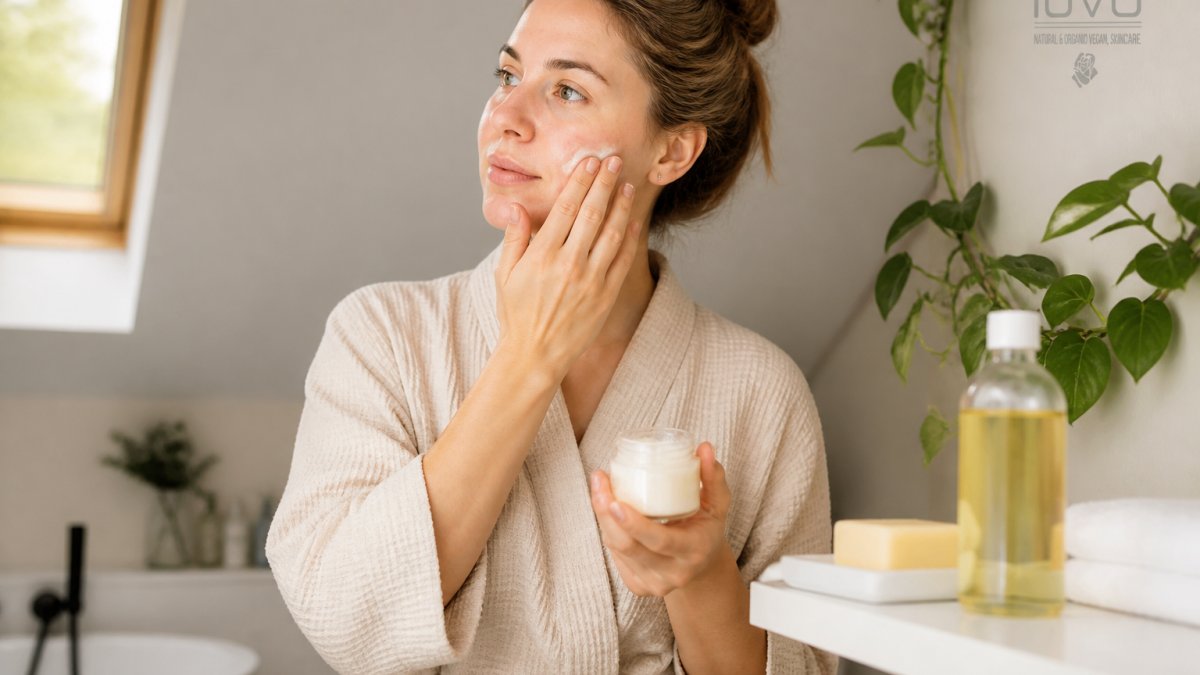
Morning:
- Rinse with lukewarm water, or use the unscented soap if you need to cleanse
- Apply the Day & Night Cream while skin is still slightly damp
- Add two or three drops of face and body oil to seal in moisture
- Wait two minutes before applying any sunscreen or makeup
Evening:
- Remove the day with the Gentle Facial Cleansing Lotion
- Apply the Deep Hydrating Butter to any dry or itchy patches
- Finish with the oil on face and body
- Apply within three minutes of bathing, while skin is damp
Patch Testing and Introducing New Products Safely
Patch testing is the step almost everyone skips, and it prevents a week of misery. Apply a small amount to the inner forearm, cover it, and leave it 48 hours without washing. If there is no redness, itching or stinging, test a small patch behind the ear before using it on your face.

Introduce one product at a time, with at least three days between new items. If a flare-up happens, you will know exactly what caused it.
What Not to Put on Eczema Skin: Ingredients to Avoid
Knowing what not to put on eczema skin is as important as knowing what to use. The list below is not "bad chemicals", it is ingredients that either strip the skin's lipid barrier, sit on top of it and trigger an immune reaction, or both. Understanding the mechanism helps you judge any product.
Ingredients to avoid, and why
- Sodium lauryl sulphate (SLS) and sodium laureth sulphate (SLES): high-foaming surfactants that lift oils out of the skin faster than the barrier can replace them. SLS is the more aggressive. Look for it in foaming washes, shampoos and even some "gentle" cleansers.
- Synthetic fragrance and "parfum": fragrance mixes are among the most frequently reported causes of contact reactions in eczema-prone skin. "Parfum" can hide dozens of compounds, so a product can be marketed as fragrance-free while still containing a masking fragrance.
- Essential oils and plant extracts in high concentration: lavender, tea tree, citrus, eucalyptus and geranium oils are common triggers. "Natural" describes origin, not tolerability, a concentrated essential oil can irritate more than a mild synthetic.
- Drying alcohols: denatured alcohol, ethanol and isopropyl alcohol make a product feel light and fast-drying. On impaired skin they leave a tight, flaky finish and pull moisture from the upper layers.
- Preservatives with a high sensitisation profile: methylisothiazolinone (MI) and methylchloroisothiazolinone (MCI) are most often flagged in patch-testing clinics, and some people react to formaldehyde-releasing preservatives. Parabens are widely used and generally well tolerated; avoiding them is a preference, not a medical requirement.
- Physical and chemical exfoliants: scrubs, salicylic acid, glycolic acid, lactic acid and retinoids speed up cell turnover, which on a compromised barrier means more irritation, not smoother skin. Urea is a special case: at low concentrations it is a humectant, but at higher concentrations it exfoliates and can sting.
- Cooling agents and counter-irritants: menthol, camphor and peppermint feel soothing briefly, then often provoke more itch.
Ingredients worth seeking out
- Humectants: glycerin, hyaluronic acid, panthenol (provitamin B5) and sodium PCA draw water into the upper skin layers.
- Emollients: shea butter, cocoa butter, jojoba oil, squalane, ceramides and fatty alcohols such as cetyl and stearyl alcohol. Fatty alcohols are not drying alcohols, they are waxy and occlusive.
- Occlusives: petrolatum, dimethicone and lanolin. Petrolatum is one of the most effective barrier agents available, with a very low reaction rate. Lanolin is excellent for many but a known allergen for a minority.
- Soothing agents: colloidal oatmeal, allantoin, bisabolol and low-percentage niacinamide.
- Ceramides and cholesterol: the skin's barrier is built from ceramides, cholesterol and free fatty acids. Products supplying these in roughly physiological ratios support repair rather than just sitting on the surface.
How to read a label in 60 seconds
- Check the first five ingredients. Anything above 1% must be listed in descending order, so the top of the list tells you what the product mostly is.
- Search for "parfum", "fragrance", "aroma" and "essential oil". If any appear, treat the product as fragranced regardless of the front of the pack.
- Look for the preservative names. MI and MCI are most worth avoiding if you have reacted before.
- Ignore the claims. "Dermatologically tested", "hypoallergenic", "natural" and "clean" are marketing terms, not regulated standards. "Fragrance-free" is more meaningful than "unscented", which can legally mean a masking fragrance was added.
- Check the format. A thick ointment in a tube is usually a better barrier than a lotion in a pump, because lotions are mostly water.
Matching Products to Severity, Body Area and Skin Type
Product choice should follow three questions, in this order: how severe is the eczema right now, where on the body is it, and what is the skin type there? Get those right and the format almost picks itself; get them wrong and even a good product will feel too light or too greasy to use consistently.
Step 1: Match the format to severity
| Severity | What it looks like | Format that suits it |
|---|---|---|
| Mild, dry patches | Occasional flaking, mild itch, no broken skin | Lotion or light cream, applied twice daily |
| Moderate | Persistent dryness, visible redness, regular itching | Cream or rich butter, applied at least twice daily |
| Severe or flaring | Cracked, weeping, thickened or very itchy skin | Ointment or thick butter, applied generously and often |
Lotions are mostly water, so they feel pleasant but evaporate quickly. Ointments are mostly oil or petrolatum, so they feel heavy but hold moisture far longer. Creams sit in between. For very dry skin, a thick butter applied generously outperforms a light lotion every time, format matters more than brand.
Step 2: Match the format to body area
- Face: lighter creams and oils, because heavy occlusives can clog pores and are hard to wear under sunscreen or makeup. Facial skin is thinner, so it reacts faster to strong actives.
- Hands: one of the most washed and least moisturised areas. A thick cream or ointment after every wash, plus cotton gloves overnight, makes a visible difference within a week.
- Body and limbs: rich butters and ointments, applied in the direction of hair growth to reduce follicular irritation.
- Scalp and hairline: oils and lotions rather than heavy butters, which are difficult to wash out without stripping the scalp.
- Eyelids and around the eyes: the thinnest skin on the body. Use plain emollients and avoid anything fragranced; prescription options here differ from those used elsewhere.
Step 3: Match to skin type
- Dry and tight: oil-based or cream cleansers, no foaming washes, and a rich moisturiser applied within three minutes of washing.
- Oily or combination, but still eczema-prone: a mild gel or lotion cleanser and a light cream. Do not reach for a foaming wash just because skin is oily, the squeaky-clean feeling is the barrier being stripped.
- Reactive or previously patch-tested positive: keep the routine short. Fewer products means fewer variables when something goes wrong.
A worked example
A reader with moderate eczema on the shins, dry but not broken, and no facial involvement would do well with a thick butter twice daily plus after every shower, and a soap-free wash. A reader with mild facial eczema and oily skin would do better with a lotion cleanser and a light cream, with a few drops of oil only on dry patches. Same condition, different formats.
If you are building a routine on a budget
The two products that do the most work are a gentle cleanser and a rich moisturiser. Everything else, oils, facial creams, balms, is an upgrade, not a requirement. Start with those two, use them consistently for two to four weeks, then add a third product only if something is still missing.
When Skincare Is Not Enough: Seeking Medical Care
Skincare manages symptoms but does not treat the underlying inflammation of moderate to severe eczema. If your skin is not improving after two to four weeks of consistent emollient use, speak to a GP or pharmacist.
Prescription options include topical steroids to calm inflammation and calcineurin inhibitors for sensitive areas such as the face and eyelids. Antihistamines may help with itch-disturbed sleep, and bandaging can support absorption in stubborn areas. These are medical decisions, not skincare ones.
Seek urgent advice if skin is weeping, crusting, hot to the touch or painful, as these can signal infection. The NHS guide to treating atopic eczema sets out when to escalate care.
Building Your Eczema Skincare Routine: What to Buy First
Building a routine from scratch, we would begin with the Soothing Unscented Face & Body Soaps at £4.00 and the Deep Hydrating Unscented Face & Body Butters at £9.00, £13.00 for the essentials. Add the Rosehip, Grapeseed & Jojoba oil in the 30ml size at £9.00 once skin has settled, and move to the Nourishing Day & Night Cream at £34.00 when you want a dedicated facial product.
Buy one item at a time and give each three days. Slow is faster with eczema-prone skin.
Managing eczema-prone skin is a long game, and the products that help most are usually the simplest. Iuvo Skincare makes that easier with a small, handmade range that is vegan certified, cruelty-free, and free from parabens, sulphates and palm oil, so you are not reading labels for hours to find something safe. Our Deep Hydrating Butters and Rosehip, Grapeseed & Jojoba Oil are built around barrier support and itch relief, while the unscented soap gives reactive skin a cleansing option with nothing added. Search our store to build a routine that calms your skin instead of challenging it.
Frequently Asked Questions
What should I look for in skincare for eczema-prone skin?
Look for fragrance-free, non-soap cleansers and rich emollient moisturisers. Check labels for short ingredient lists built around shea butter, jojoba, rosehip or grapeseed oil, which support the skin barrier and help with moisture retention. Avoid anything with added perfume, sulphates or alcohol, as these strip the skin and can trigger a flare-up. A simple three-step routine of cleanse, moisturise and protect is often more effective than a long list of products.
What is the best face wash for eczema?
A gentle, non-soap cleanser is the safest choice. The Soothing Unscented Face & Body Soaps (£4.00) contain no essential oil and are made for sensitive, eczema and psoriasis-prone skin. If you prefer a cream texture, the Gentle Facial Cleansing Lotion (£8.00) with avocado and castor oil leaves skin soft and hydrated. Whichever you pick, wash with lukewarm water, keep it brief, and moisturise within three minutes while skin is still damp.
What should I avoid putting on eczema skin?
Avoid fragrance, essential oils in high concentrations, sulphates, parabens and anything with a long list of synthetic additives. Alcohol-based toners and exfoliating acids are also best left alone during a flare-up, as they remove the oils your skin barrier needs. Even some products marketed as natural can irritate, so patch test anything new on a small area of inner forearm for 48 hours before using it on your face or a large area of your body.
Can I use face moisturiser on eczema-prone skin?
Yes, and you should use it daily. A rich, easily absorbed cream such as the Nourishing Day & Night Cream (£34.00) or the Deep Hydrating Unscented Face & Body Butters (£9.00) helps replace lost moisture and supports the skin barrier. Apply straight after cleansing while skin is still slightly damp, and reapply through the day whenever skin feels tight or dry. If your skin stings on application, stop and check the ingredient list.
When should I see a doctor about my eczema?
See a GP or pharmacist if your skin is weeping, crusting, hot to touch or painful, as this can signal an infection. Also seek help if over-the-counter emollients and gentle skincare have not improved things after a few weeks, if sleep is badly disrupted by itching, or if the affected area keeps spreading. Prescription treatments such as topical steroids or calcineurin inhibitors may be needed alongside your daily routine.


