

Table of Contents
- What Greenwashing in Skincare Actually Looks Like
- Common Misleading Marketing Buzzwords to Watch For
- How to Read Skincare Ingredient Labels Like a Formulator
- Why Avoid Palm Oil Skincare Products and How to Spot Them
- The CMA Green Claims Code for Beauty Brands Explained
- Third-Party Certifications: How to Verify Them Independently
- Digital Tools and Apps for Scanning Skincare Products
- The Difference Between Clean Beauty and Green Beauty
- Packaging Lifecycle: What Brands Don't Tell You
- Red Flags in Ingredient Lists That Signal Deceitful Tactics
- How Greenwashing Erodes Consumer Trust in Sustainable Beauty
- Building a Verification Routine for Eco-Conscious Consumers
- Conclusion: Shopping with Confidence in 2026
- Frequently Asked Questions
Last Updated: September 21, 2026
What Greenwashing in Skincare Actually Looks Like
Greenwashing in skincare is the practice of making a brand appear more environmentally friendly or natural than it genuinely is, through vague claims, misleading imagery, or selective disclosure. According to the Competition and Markets Authority's guidance on environmental claims, such claims must be truthful, clear, and substantiated. At Iuvo Skincare, we've watched this problem grow as eco-conscious consumers drive demand for sustainable beauty.
The tell is rarely a single dramatic lie. It's a pattern: a leaf icon here, a "chemical-free" badge there, and a supply chain nobody can trace. Below, we'll show you exactly how to identify greenwashing in skincare brands using the same checks a formulator or compliance officer would run.
The Seven Sins of Greenwashing in Cosmetics
TerraChoice's original "Seven Sins" framework still maps cleanly onto beauty. The most common sins are the hidden trade-off (one green attribute masking everything else), no proof, vagueness, false labels, irrelevance, the lesser of two evils, and outright fibbing.
A "natural" shampoo in a plastic bottle flown halfway around the world commits the hidden trade-off. A "planet-friendly" claim with no certification behind it commits vagueness and no proof at the same time.
The Advertising Standards Authority's guidance on environmental claims treats unsubstantiated green claims as misleading advertising. That matters: the sin isn't just ethical, it's actionable.
Common Misleading Marketing Buzzwords to Watch For
Certain words appear so often in green marketing that they've lost meaning. Treat these as prompts to investigate, not as evidence of anything:
- "Chemical-free", impossible; water is a chemical. Signals either ignorance or intent to mislead.
- "Non-toxic", undefined in law, and used to imply competitors are toxic.
- "Clean", a marketing term, not a regulatory one. See the Clean Beauty vs Green section below.
- "Eco-friendly", meaningless without a specific, verifiable claim attached.
- "Natural", no legal definition in cosmetics. Poison ivy is natural.
- "Hypoallergenic", suggests reduced allergy risk, but has no agreed standard.
- "Plastic-free", often true of the outer box and false of the inner pump.
- "Biodegradable", true only under specific conditions; a formula that breaks down in an industrial composter may sit intact in a landfill for years.
- "Carbon-neutral", usually achieved through offsetting rather than reduction, and offsets vary wildly in quality.
- "Sustainable", a direction of travel, not a measurable endpoint. Without a stated metric it means nothing.
What most guides miss is that these words aren't illegal on their own. They become greenwashing when they're the only thing supporting an environmental or safety claim.
The Buzzword Stress Test
Rather than memorising a banned-words list, run any claim through four questions. This is the step most competitor guides skip entirely.
- What is the specific claim? "Eco-friendly" fails immediately because it names no attribute. "Packaged in 100% recycled card" passes because it names one.
- What is the evidence? A certification number, a published figure, or a named supplier. If the brand can't point to one, the claim is decoration.
- What is the scope? Does it cover the whole product, one component, or the whole brand? A recycled outer box says nothing about the formula inside.
- What is being left out? Every claim has a boundary. "Vegan" says nothing about palm oil. "Cruelty-free" says nothing about packaging. The omission is often the story.
A claim that survives all four questions is usually a real one. A claim that fails at question one or two is the pattern to walk away from.
Why the Same Words Keep Working
The reason these buzzwords persist is that they're cheap to produce and hard to disprove. A brand that writes "natural" on a label incurs no cost and takes on no measurable obligation. A brand that writes "98% naturally derived, certified by [named scheme]" takes on both.
That asymmetry is the whole game. When you see a brand leaning on undefined vocabulary, you're usually looking at a business that has calculated the cost of specificity and declined to pay it. The Advertising Standards Authority's guidance on environmental claims treats unsubstantiated green claims as misleading advertising, which means the vague word is not just lazy, it's the thing regulators are actively looking for.
How to Read Skincare Ingredient Labels Like a Formulator
Read the INCI list, not the front of the pack. The International Nomenclature of Cosmetic Ingredients is the standardised naming system required on cosmetic labels, and it's where the truth lives. Everything present above 1% must be listed in descending order of concentration.
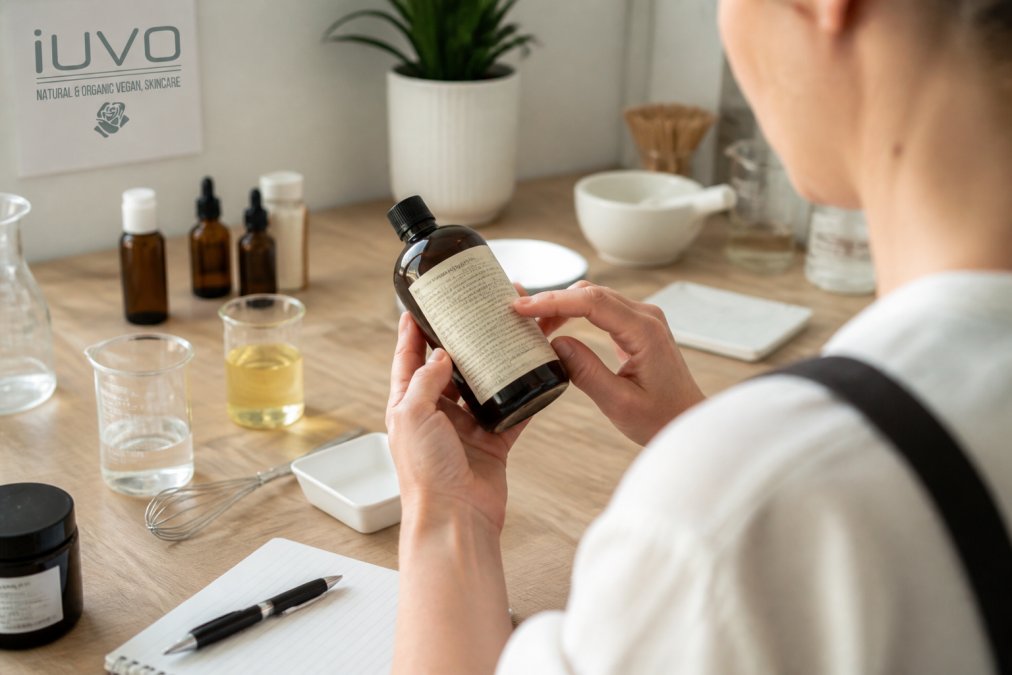
Start at the top. The first five ingredients usually make up the bulk of the formula. If a brand claims "rosehip-rich" and rosehip sits at position 22, the claim is decorative.
INCI Names vs Marketing Names
This is where greenwashing hides in plain sight. Brands use the botanical marketing name on the front and the INCI name on the back, hoping you won't connect them.
Marketing Name |
INCI Name |
What It Actually Is |
|---|---|---|
"Coconut-derived cleanser" |
Sodium Cocoyl Isethionate |
A surfactant, not coconut |
"Vitamin B5" |
Panthenol |
A humectant |
"Natural fragrance" |
Parfum / Fragrance |
Undisclosed blend, often synthetic |
"Aloe vera" |
Aloe Barbadensis Leaf Juice |
Genuine, but often under 1% |
The "fragrance" entry is the biggest loophole. It can legally conceal dozens of compounds. For sensitive skin, eczema, or psoriasis, that's the ingredient to interrogate hardest.
Why Avoid Palm Oil Skincare Products and How to Spot Them
Palm oil is the ingredient most often hidden behind INCI names, which is exactly why it's a greenwashing red flag. It appears as Elaeis Guineensis oil, Sodium Palmate, Sodium Palm Kernelate, Palmitic Acid, or Cetyl Palmitate, none of which signal "palm" to a casual reader.
The environmental case is well documented: palm oil drives deforestation, habitat loss, and carbon emissions in tropical regions, and "sustainable" certification schemes have been criticised for weak enforcement. Many eco-conscious consumers now avoid it entirely, and brands that claim to be sustainable while quietly using palm derivatives are committing a textbook hidden trade-off.
Iuvo Skincare formulates without palm oil across the range, which is one reason our ingredient lists read shorter than most. If a brand markets itself as rainforest-friendly, scan the INCI list for the six names above before you believe it.
The CMA Green Claims Code for Beauty Brands Explained
The CMA Green Claims Code for beauty brands sets out six principles that environmental claims must follow. The Green Claims Code published by the Competition and Markets Authority requires claims to be truthful and accurate, clear and unambiguous, complete, substantiated, comparable, and about the full lifecycle of the product.
That last principle catches a lot of brands out. A "carbon-neutral" claim that accounts only for manufacturing, while ignoring packaging, transport, and disposal, fails the completeness test.
The CMA has signalled it will take enforcement action against brands making misleading environmental claims, working alongside the Advertising Standards Authority. For shoppers, the practical takeaway is simple: if a brand can't tell you which principle its claim satisfies, the claim probably doesn't satisfy any of them.
Third-Party Certifications: How to Verify Them Independently
Certifications are only as good as your ability to check them. A logo on a website means nothing if the brand isn't actually listed in the certifier's directory, and this is one of the most common greenwashing tactics in the sector.
Verification takes about two minutes per claim:
Soothing Unscented Face & Body Soaps →
- Note the exact certification name and logo.
- Go to the certifier's official website, not the brand's.
- Search their public directory for the brand or product name.
- Check the scope: does the certification cover the whole brand or one product?
- Check the expiry date, if listed.
Vegan and cruelty-free claims deserve the same scrutiny. Look for certifying bodies with searchable registers rather than self-declared badges. Iuvo Skincare holds vegan certification, and you can trace it independently rather than taking our word for it.
Digital Tools and Apps for Scanning Skincare Products
Barcode-scanning apps have made label verification dramatically faster than it was five years ago. Most work the same way: scan the barcode, pull the INCI list from a database, and flag ingredients against your personal criteria.
What they're good at:
- Surfacing the full INCI list when the pack is hard to read
- Flagging known irritants and common allergens
- Comparing formulations across similar products
Where they fall short:
- Databases are incomplete, especially for small-batch and handmade products
- Ingredient flags often lack context about concentration
- Sustainability and sourcing data is rarely included
Use them as a first filter, not a verdict.
The Difference Between Clean Beauty and Green Beauty
Clean beauty refers to formulations free from a brand's chosen "free-from" list, usually parabens, sulphates, and synthetic fragrance. Green beauty refers to environmental impact: sourcing, packaging, carbon, and waste.
Packaging Lifecycle: What Brands Don't Tell You
Packaging is where sustainability claims most often collapse. A recyclable glass jar inside a plastic-lined cardboard box, shipped in virgin plastic mailers, is recyclable in name only.
The Component Audit
A skincare product is rarely one material. It's a stack, and the claim usually applies to the easiest part of the stack. Break any product down before you believe the label:
- Primary container, the bottle, jar, or tube that holds the formula. Rigid and often genuinely recyclable.
- Dispenser, pump, dropper, spray trigger, or disc top. Usually mixed materials and rarely recyclable kerbside.
- Liner or inner coating, the invisible layer that makes a card box greaseproof or a tube squeezable. Often plastic film bonded to paper, which contaminates both streams.
- Closure, cap, lid, or ring. Sometimes recyclable, sometimes not, and frequently a different polymer from the bottle.
- Outer packaging, the box. The easiest component to make recyclable and the one brands most like to cite.
- Secondary and transit, mailers, void fill, tape, and labels. Almost never mentioned in marketing.
Refills, Concentrates, and the Circularity Test
Refill systems are the clearest signal of genuine intent, because they require real infrastructure rather than a logo change. But not all refills are equal, and the differences matter:
- Refill at home, a concentrate or tablet you add water to. Lowest shipping weight, lowest packaging, but shifts effort to you.
- Refill in store, a dispenser you top up from. Genuinely circular, but only where the store network exists.
- Refill by post, a pouch or pod mailed to you. Better than a new bottle, but the pouch itself is usually the unrecyclable component.
- Return and reuse, the brand takes the container back, sanitises it, and refills it. The strongest model, and the rarest, because it requires reverse logistics.
What to Ask Before You Believe a Packaging Claim
- Is the primary container actually accepted in household collection where you live?
- Does it contain a pump, dropper, or liner that isn't?
- Is refill available, and is it cheaper than buying new?
- Is the outer packaging necessary at all, or is it there to make the product look premium?
- Does the brand publish the material specification, or just the word "recyclable"?
Beware of "plastic-free" claims that apply only to the outer box. The test is whether the part that touches the product is free of it too.
Red Flags in Ingredient Lists That Signal Deceitful Tactics
Certain patterns in an INCI list should make you slow down:
- "Parfum" or "Fragrance" listed high, an undisclosed blend, often the trigger for reactive skin
- A hero ingredient at position 20+, the claim is marketing, not formulation
- "Chemical-free" anywhere on the pack, a factual impossibility
- No INCI list at all, a legal requirement in most markets
- Vague botanical blends, "essential oil blend" with no breakdown
- Preservative-free claims on water-based products, either untrue or a microbial risk
How Greenwashing Erodes Consumer Trust in Sustainable Beauty
Greenwashing doesn't just mislead the individual shopper; it corrodes the entire sustainable beauty market. When consumers repeatedly discover that "natural" and "eco-friendly" claims mean nothing, they stop believing the brands that are genuinely doing the work.
Building a Verification Routine for Eco-Conscious Consumers
A repeatable routine beats one-off research. This is the same sequence we'd suggest running before any skincare purchase, and it takes about five minutes per product.
Step |
Action |
What You're Checking |
|---|---|---|
1 |
Read the INCI list, top to bottom |
Hero ingredients in the first five |
2 |
Scan for hidden palm derivatives |
Palmate, palm kernelate, Elaeis Guineensis |
3 |
Search the certifier's register |
Vegan, cruelty-free, organic claims |
4 |
Check the packaging lifecycle |
Refills, liners, outer box necessity |
5 |
Test on a small area first |
Suitability for sensitive or reactive skin |
Conclusion: Shopping with Confidence in 2026
The vocabulary of sustainable beauty has been stretched so far that it no longer carries reliable meaning, which means the burden of verification now sits with you. That's an unfair position for any shopper, especially one managing sensitive skin, eczema, or psoriasis.
Frequently Asked Questions
What are the most common signs of greenwashing in the beauty industry?
Look for vague terms like 'natural' or 'eco-friendly' without certification, hidden ingredients behind proprietary blends, and imagery of leaves or green colours that imply environmental benefit without proof. Another sign is a brand highlighting one small sustainable action, such as recyclable packaging, while ignoring larger issues like supply chain accountability or carbon footprint. If a claim cannot be verified through a recognised third-party certification or published sustainability reporting, treat it with caution.
How can I verify if a skincare brand is truly sustainable?
Start by checking for third-party certification logos such as COSMOS, Soil Association, or Leaping Bunny. Visit the certifying body's website to confirm the brand is listed. Then review the brand's ingredient transparency: do they publish full INCI lists? Do they explain their ethical sourcing policies? Finally, use digital tools and apps that scan product barcodes to cross-reference claims against ingredient databases. A genuinely sustainable brand will welcome this scrutiny and provide clear, accessible information.
Why is palm oil often a red flag in skincare marketing?
Palm oil production is linked to deforestation, habitat loss, and poor supply chain accountability in some regions. Brands that claim to be eco-friendly while using unsustainably sourced palm oil or its derivatives (often listed as sodium palmitate or elaeis guineensis) are contradicting their own green marketing. If a brand uses palm oil, look for Roundtable on Sustainable Palm Oil (RSPO) certification. If they avoid it entirely, that removes one layer of environmental concern, though it does not automatically make the whole product sustainable.
What is the difference between 'natural' and 'organic' in skincare labelling?
In the UK, 'natural' is largely unregulated in cosmetics and can mean almost anything. 'Organic' is also loosely used unless the product carries a recognised certification such as COSMOS Organic or Soil Association. A product labelled organic without certification may contain only a tiny percentage of organic ingredients. Always check the certification logo and the percentage of organic content stated on the pack. If no certifier is named, treat the claim as green marketing rather than a verified standard.
How do UK consumer protection laws address misleading environmental claims?
The Competition and Markets Authority (CMA) enforces the Green Claims Code, which requires environmental claims to be truthful, clear, and substantiated. Under the Consumer Protection from Unfair Trading Regulations 2008, misleading claims can lead to enforcement action. The Digital Markets, Competition and Consumers Act 2024 strengthens these powers further. If you believe a skincare brand is making false environmental claims, you can report it to the CMA or Trading Standards.
What are some examples of greenwashing brands?
Specific brand names change as regulators investigate, so it is more useful to recognise patterns. Common examples include brands that label products 'chemical-free' when all substances are chemicals, brands that use 'clean beauty' without defining what clean means, and brands that promote a single recyclable component while the rest of the packaging is mixed plastic. Others use unregulated buzzwords like 'non-toxic' to imply safety without evidence. Recognising these patterns helps you evaluate any brand, including those not yet publicly challenged.
How can digital tools help me identify greenwashing in skincare?
Apps like Think Dirty, INCI Decoder, and Yuka let you scan a product barcode and see ingredient breakdowns, potential irritants, and environmental flags. Some cross-reference certifications and highlight unregulated buzzwords. These tools are not perfect, as databases can be incomplete, but they provide a useful starting point for label verification. Combine app results with a manual check of the brand's certification status and published sustainability reporting for a fuller picture.
What should I look for in packaging to assess environmental impact?
Check whether the packaging is refillable, recyclable, or compostable, and whether the brand offers a take-back scheme. Look for mono-material packaging, which is easier to recycle than mixed materials. Be cautious of 'biodegradable' claims on plastic, as these often require industrial conditions not available in home composting. A brand that explains its packaging lifecycle analysis openly is more trustworthy than one that simply prints a green leaf symbol.


