

Table of Contents
- Why Your Skin Itches: Understanding the Scratch Cycle
- What You'll Need Before You Start Treating Itchy Skin
- Step 1: Switch to Lukewarm Baths and a 10-Minute Limit
- Step 2: Apply an Unperfumed Emollient Within Three Minutes of Drying
- Natural Remedies for Dry Itchy Skin That Are Worth Trying
- How to Stop Skin Itching at Night: A Step-by-Step Routine
- Diet, Stress and the Psychological Toll of Chronic Itching
- When to See a GP for Itchy Skin
- Common Mistakes That Make Itchy Skin Worse
- Conclusion: Build a Routine You Can Actually Keep
- Frequently Asked Questions
Last Updated: September 18, 2026
Why Your Skin Itches: Understanding the Scratch Cycle
Itchy skin, known medically as pruritus, is your nervous system's way of signalling that something is irritating the skin barrier. That signal triggers an urge to scratch, which damages the skin further and releases more itch-causing chemicals. The cycle repeats.
This guide from Iuvo Skincare breaks that loop with nine practical steps. Most people can calm itching at home within days. The key is acting fast and avoiding the habits that make it worse.
Here's what most guides get wrong: they treat the itch, not the cause. Dryness, irritants, heat and stress all feed the scratch cycle. Fix those and the itch fades.
The NHS guidance on itching notes that persistent itching can also point to an underlying condition, so knowing when to seek help matters.
What You'll Need Before You Start Treating Itchy Skin
Gather a few basics first. Having them ready makes the routine easier to stick to.
- An unperfumed emollient or thick moisturiser
- A gentle, hypoallergenic cleanser
- Soft cotton clothing and bedding
- A cool, damp towel for emergencies
- An antihistamine, if your GP or pharmacist suggests one
Check labels for fragrance, alcohol and harsh sulphates. These irritate a damaged skin barrier.
A common mistake is buying a "natural" product that still contains essential oils. Some skins react to those too. Patch test anything new on your inner forearm for 48 hours.
Step 1: Switch to Lukewarm Baths and a 10-Minute Limit
Hot water strips the oils that protect your skin. It feels good in the moment, then leaves you drier and itchier.
Keep baths and showers lukewarm. Limit them to about ten minutes. Skip bubble baths and heavily perfumed soaps, which leave irritant residue on the skin.
- Water temperature: lukewarm, not hot
- Time limit: ten minutes or less
- Products: unperfumed and soap-free where possible
Pat your skin dry rather than rubbing. Rubbing tugs at the epidermis and sparks more itching.
Step 2: Apply an Unperfumed Emollient Within Three Minutes of Drying
Timing matters more than the brand. Moisturiser traps water in the skin, but only if you apply it while the skin is still damp.
Within three minutes of drying, smooth on a generous layer of unperfumed emollient. This locks in hydration and rebuilds the skin barrier.
For very dry or eczema-prone skin, a rich butter works well. Iuvo Skincare's NOURISH Deep Hydrating Unscented Face & Body Butters contain jojoba oil, which helps prevent itching, and coconut oil to soothe. Apply two to three times daily, and always after washing.

Natural Remedies for Dry Itchy Skin That Are Worth Trying
Natural remedies for dry itchy skin can calm irritation between moisturising sessions. They work best alongside a good emollient, not instead of one.
- Colloidal oatmeal: Add to a lukewarm bath to soothe inflammation.
- Menthol: Gives a cooling sensation that distracts from the itch.
- Cool compress: A damp towel on the area numbs the urge to scratch.
- Oat-based creams: Gentle enough for sensitive, eczema-prone skin.
Avoid undiluted essential oils, lemon juice and vinegar. These irritate broken skin and can make things worse.
The National Eczema Society recommends keeping the skin hydrated and avoiding known irritants as the foundation of any routine.
How to Stop Skin Itching at Night: A Step-by-Step Routine
Night-time itching is not imagination. It follows a predictable pattern, and once you understand the mechanism you can plan around it.
Three things converge after dark. First, the body's natural cortisol level dips in the evening, and cortisol is one of the body's own anti-inflammatory brakes. Second, skin temperature rises under duvets and blankets, and warmth amplifies itch signalling. Third, the skin loses water overnight through transepidermal water loss, so a barrier that felt fine at 6pm can feel tight and prickly by 2am. Add a quiet room with no distractions and the itch becomes the only thing your brain has to focus on.
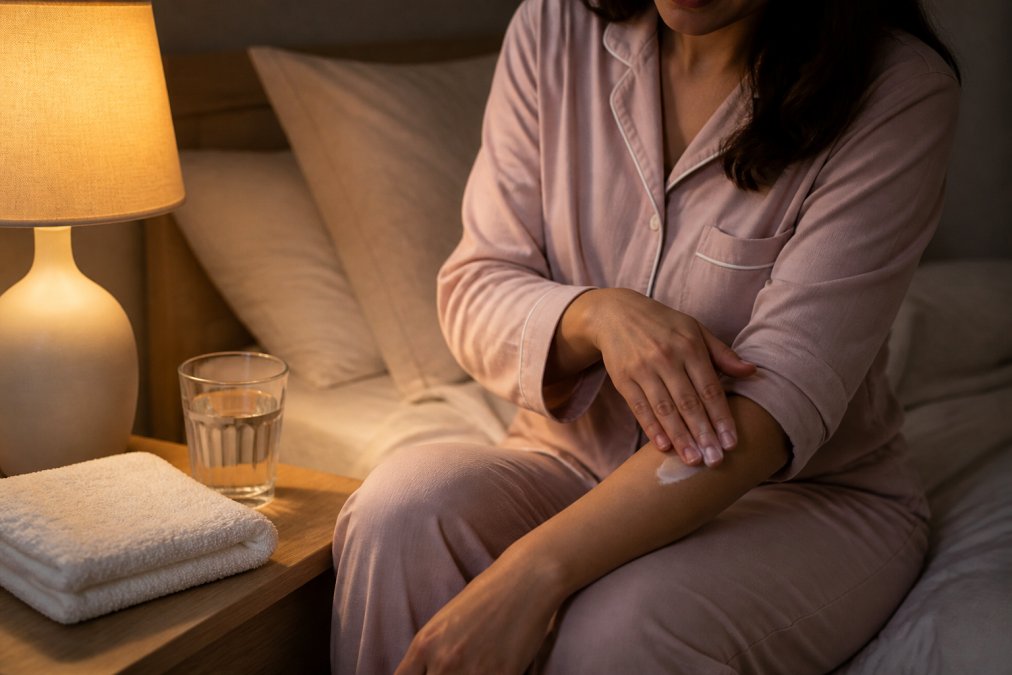
The routine below works because it front-loads hydration, removes heat and friction, and gives you a plan for the 3am wake-up.
About 90 minutes before bed
- Take a lukewarm bath or shower, aim for around 32-37°C, which feels tepid rather than warm. Anything hotter strips lipids from the stratum corneum and leaves the barrier weaker overnight.
- Keep it under ten minutes and use an unperfumed, soap-free cleanser. Bubble bath, shower gels with fragrance and heavily foaming products leave irritant residue in the skin folds.
- Pat dry, do not rub. Rubbing creates micro-abrasions that itch more once the skin warms up in bed.
Within three minutes of stepping out
- Apply a generous layer of unperfumed emollient while the skin is still slightly damp. Ointments and thick butters (look for petrolatum, shea, jojoba or coconut oil high on the ingredient list) hold water in better than thin lotions. Lotions are mostly water and evaporate; ointments and butters seal.
- Give the emollient ten minutes to absorb before dressing. This prevents it transferring to pyjamas and leaving the skin surface dry again.
Setting up the bedroom
- Keep the room cool, most people sleep best between about 16-18°C. Overheating is one of the most common and most overlooked itch triggers.
- Choose loose, breathable cotton pyjamas and cotton bedding. Wool, polyester and brushed synthetics trap heat and create friction against the skin.
- If the air is dry (central heating in winter, air conditioning in summer), a humidifier can help. Aim for a relative humidity around 40-50%. Too damp and dust mites thrive, which is its own trigger for some people.
- Wash bedding weekly at a hot setting if you suspect dust mites, and avoid fabric conditioner, which leaves a waxy residue that can irritate sensitive skin.
Protecting against the scratch itself
- Trim your nails short and file the edges smooth. Most night-time damage is done unconsciously.
- If you scratch in your sleep, cotton gloves or soft cotton socks over the hands reduce the damage without feeling restrictive. Some people find a smooth, cool gel-filled mitt more comfortable than fabric.
- Keep a cool, damp towel or a gel pack in a bedside cooler. When the itch wakes you, press it on the area for 30-60 seconds. Cold overrides the itch signal at the nerve level, which is why it works faster than scratching.
- Do not reach for a hot shower at 3am. It feels soothing for a minute and then rebounds worse.
If you still wake up itching
A common pattern is that the itch is worst in the first two hours of sleep, then again in the early hours when body temperature fluctuates. If you are waking most nights, that is a signal to see a GP rather than keep adjusting the routine. Persistent night-time itch is one of the classic presentations of eczema, psoriasis, iron deficiency, thyroid problems and, less commonly, more serious conditions. A GP can arrange blood tests and, if needed, refer you to a dermatologist.
Soothing Unscented Face & Body Soaps →
Try a Sensitive Face Wash with Rose Geranium if your face itches at night. It calms sensitive skin while removing the day's debris.

Diet, Stress and the Psychological Toll of Chronic Itching
Most guides treat itching as a skin problem. For anyone who has lived with it for weeks or months, it is also a sleep problem, a concentration problem and a mood problem, and those feed straight back into the skin.
The mind-body loop, explained
Itch and stress share wiring. When you are stressed, the body releases cortisol and adrenaline, which ramp up inflammation and make nerve endings in the skin more sensitive. That lowers your itch threshold, the point at which a stimulus becomes an itch, so the same dry patch that was tolerable yesterday feels unbearable today. Poor sleep makes it worse: sleep deprivation raises inflammatory markers and reduces the skin's ability to repair its barrier overnight. The result is a loop where itching disrupts sleep, sleep loss worsens itching, and the frustration of both raises stress further.
This is not 'just in your head'. Chronic itch is recognised as having a real psychological burden, and it is one of the most common reasons people seek help for skin conditions. If you are lying awake scratching, you are not weak-willed, you are in a loop that needs breaking from more than one direction.
What actually helps the psychological side
- Name it. Telling a GP that the itch is affecting your sleep or mood is not oversharing. It changes what they can offer, from sleep support to referral.
- Protect sleep hygiene. A consistent bedtime, no screens for the last hour, and a cool dark room all reduce the arousal that makes itch feel louder.
- Try paced breathing before bed. Slow breathing (around six breaths per minute) dampens the sympathetic nervous system and can take the edge off night-time itch.
- Use distraction deliberately. Itch is worse when you are idle. A podcast, an audiobook or a gentle craft gives your attention somewhere else to go.
- Move gently. Walking, yoga or swimming (rinse well afterwards) reduce stress without overheating the skin. Intense exercise that leaves you sweaty and hot can trigger a flare.
- Talk to someone. If low mood or anxiety persists for more than a couple of weeks, speak to your GP. Talking therapies are available and can be accessed without a skin diagnosis.
Diet: what the evidence actually supports
Diet is where a lot of itchy-skin advice goes wrong. There is no single 'itch-free' diet, and cutting out whole food groups without guidance can do more harm than good. But a few patterns are worth knowing.
- Alcohol dilates blood vessels and can trigger flushing and itching within minutes in some people. If you notice a pattern, try a few alcohol-free weeks and see.
- Spicy food contains capsaicin, which activates the same nerve receptors involved in itch. For some people this is a direct trigger.
- High-histamine foods, aged cheese, cured meats, fermented foods, some wines, can worsen itching in people whose histamine handling is already stretched. This is more common than most people realise.
- Hydration matters more than any single food. A well-hydrated body supports a healthier skin barrier. Aim for pale straw-coloured urine as a rough guide.
- Omega-3 fats (oily fish, walnuts, flaxseed) support the skin's lipid barrier. The evidence is modest but the downside is low.
- Vitamin D is worth checking if you have darker skin, cover up for cultural or religious reasons, or live in northern latitudes. Low levels are common and can affect skin health.
How to test a trigger without guessing
Keep a simple diary for two to three weeks. Log what you ate, your stress level, sleep quality and itch severity on a 0-10 scale. Patterns emerge faster than you would expect. Change one thing at a time, if you cut out three foods at once and the itch improves, you have no idea which one mattered. And do not eliminate a food group long-term without speaking to a GP or dietitian, especially if you are pregnant, breastfeeding or managing another condition.
Diet alone rarely cures itching, but reducing known triggers and addressing stress can meaningfully lower the baseline. Treat the skin, the sleep and the stress together, and the loop is far easier to break.
When to See a GP for Itchy Skin
Knowing when to see a GP for itchy skin saves you weeks of guessing. Most mild itching settles with home care within a week or two.
Book an appointment if:
- The itch lasts more than two weeks
- It covers most of your body
- You also have weight loss, fever or night sweats
- The skin is cracked, weeping or infected
- Home treatments aren't helping
A GP can check for conditions such as eczema, psoriasis, allergies or thyroid problems. They may refer you to a dermatologist for patch testing or further treatment.
The NHS advises seeking help sooner if itching is severe or comes with other worrying symptoms.
Common Mistakes That Make Itchy Skin Worse
Most setbacks come from a handful of habits. Fix these and progress speeds up.
- Using hot water: It strips protective oils and dries the skin.
- Skipping moisturiser: Dry skin itches more, so hydration is non-negotiable.
- Wearing wool or rough fabrics: These irritate sensitive skin. Choose cotton.
- Scratching "just a little": Even light scratching restarts the cycle.
- Trying too many new products at once: You can't tell what helped or hurt.
Keep your routine simple. Fewer products mean fewer chances to trigger a flare.
Conclusion: Build a Routine You Can Actually Keep
The hardest part of treating itchy skin isn't finding the right steps. It's sticking to them long enough to see results. Consistency beats intensity every time.
At Iuvo Skincare, we make gentle, handmade products for sensitive skin. Our range is 100% vegan certified and free from parabens, sulphates and palm oil. The Soothing Unscented Face & Body Soaps suit eczema and psoriasis-prone skin, while the Rosehip, Grapeseed & Jojoba Face & Body Oil deeply hydrates without clogging pores.

Start with one step and build from there. Search our store to find the emollient that fits your routine.
Frequently Asked Questions
How do I make my skin stop itching right now?
Cool the area first: a cool compress or a lukewarm bath for 10 minutes calms the nerve signals that drive itching. Pat dry and apply an unperfumed emollient within three minutes while the skin is still damp, which helps lock in hydration. Keep nails short and press rather than scratch if the urge returns. If the itch is widespread, an antihistamine may help at night, but check with a pharmacist first. Persistent itchy skin that lasts more than two weeks needs a GP review.
What is the main cause of itchy skin?
Most everyday itching comes from a damaged skin barrier, which lets irritants in and moisture out. That leads to dry skin and the itch-scratch cycle, where scratching damages the epidermis further and makes the itch worse. Other triggers include allergic reactions to fragrances, soaps or fabrics, eczema and psoriasis flares, and cold or central heating. Less often, itching signals an underlying condition such as iron deficiency, thyroid problems or kidney issues, which is why ongoing pruritus should be assessed.
Can natural ingredients help soothe persistent itching?
Some do. Colloidal oatmeal, jojoba oil and rosehip oil are widely used to calm and hydrate irritated skin, and menthol in small amounts gives a cooling distraction from the itch. Look for short ingredient lists that are hypoallergenic and unperfumed, since fragrance is a common irritant. Always patch test on your inner forearm for 48 hours before applying anything to a larger area, especially if you have eczema or psoriasis.
When should I see a GP about itchy skin?
Book an appointment if itching lasts longer than two weeks, keeps you awake most nights, or covers most of your body. See a GP sooner if you also have weight loss, fever, night sweats, jaundice, or a new rash that is spreading or blistering. Itching with no visible rash can point to a thyroid, kidney or liver issue, or to a medicine side effect. A GP can examine you, arrange blood tests and prescribe stronger topical treatments if over-the-counter options have not worked.


