
Vegan Skincare for Sensitive Skin: The 2026 Guide
by Ian Gabbidon on Sep 20, 2026

Table of Contents
- Why Vegan Skincare for Sensitive Skin Is Different
- How a Damaged Skin Barrier Drives Sensitivity
- Natural Skincare Ingredients for Sensitive Skin
- Ingredients to Avoid in Vegan Skincare for Sensitive Skin
- Vegan vs Cruelty-Free vs Clean Beauty: What the Labels Mean
- How to Build a Vegan Skincare Routine for Sensitive Skin
- Choosing the Best Vegan Face Moisturiser for Sensitive Skin
- Patch Testing Vegan Skincare Products Before You Commit
- Building a Full Routine: What It Costs
- Transitioning to Vegan Skincare Without a Flare-Up
- The Environmental Impact of Plant-Based Ingredients
- Common Bad Advice About Vegan Skincare for Sensitive Skin
- Frequently Asked Questions
Last Updated: September 20, 2026
Why Vegan Skincare for Sensitive Skin Is Different
Vegan skincare for sensitive skin is different because it removes animal-derived ingredients that can trigger reactions while keeping the formulas gentle enough for a compromised barrier. That distinction matters more than most shoppers realise.
At Iuvo Skincare, we formulate every product around one question: will this calm a reactive skin barrier or provoke it? The answer usually comes down to what is left out, not what is added. A product can be entirely plant-based and still contain essential oils, sulphates or synthetic fragrance that set sensitive skin alight.
Two things separate a genuinely gentle vegan formula from a marketing claim. First, the ingredient list is short and every item has a job. Second, the product avoids the common irritants that hide behind words like "natural" and "botanical."
Below, we break down how the skin barrier works, which plant ingredients help, which to avoid, and how to build a full routine without triggering a flare-up. The guidance here reflects our approach to formulating handmade, vegan-certified products for reactive skin.
How a Damaged Skin Barrier Drives Sensitivity
A damaged skin barrier is the single most common reason sensitive skin reacts to products that other people tolerate. When the barrier weakens, moisture escapes and irritants get in. The result is redness, stinging, tightness and flare-ups of conditions such as eczema and rosacea.
The NHS guidance on eczema describes how a compromised barrier lets irritants penetrate more easily, which is why gentle, fragrance-free products are recommended for reactive skin.
What a Healthy Lipid Barrier Actually Does
A healthy lipid barrier is the thin outer layer of skin that holds water in and keeps irritants out. It is made mostly of ceramides, fatty acids and cholesterol, arranged like mortar between skin cells.
When that mortar is intact, skin stays hydrated and resilient. When it breaks down, through over-cleansing, harsh exfoliants or irritants, the same products that once felt fine start to sting. This is why a routine that worked for years can suddenly stop working.
Ceramides, Fatty Acids and Cholesterol: The Repair Trio
Ceramides, fatty acids and cholesterol are the three lipids that rebuild a compromised barrier. Formulas that supply all three, or that support the skin's own production of them, tend to repair faster than those that only add water.
Plant oils are a practical source of fatty acids. Look for oils high in linoleic acid, such as rosehip, rather than heavy occlusives that can clog pores.
Natural Skincare Ingredients for Sensitive Skin
Natural skincare ingredients for sensitive skin fall into two groups: those that soothe active inflammation and those that hold water in the skin. The best formulas combine both, because calming redness without restoring hydration only treats half the problem.
Soothing Botanicals Worth Looking For
Calendula, aloe vera, oat and chamomile are botanicals often used to calm reactive skin. Aloe vera and calendula are widely used for their soothing properties, while colloidal oat is an ingredient for itching and irritation.
Look for these near the top of an ingredient list, not buried at the bottom.
Hydration vs Moisture Retention
Hydration and moisture retention are not the same thing. Hydration means adding water to the skin. Moisture retention means stopping that water from evaporating.
Hyaluronic acid and glycerin attract water. Ceramides, shea butter and plant oils seal it in. A sensitive-skin routine needs both: a hydrating layer followed by something that holds it.
Function |
What It Does |
Ingredients to Look For |
|---|---|---|
Hydration |
Draws water into the skin |
Hyaluronic acid, glycerin, aloe vera |
Moisture retention |
Prevents water loss |
Ceramides, shea butter, jojoba oil |
Soothing |
Calms redness and stinging |
Calendula, oat, chamomile |
Barrier repair |
Rebuilds the lipid layer |
Ceramides, fatty acids, cholesterol |
Ingredients to Avoid in Vegan Skincare for Sensitive Skin
Ingredients to avoid in vegan skincare for sensitive skin include fragrance, essential oils, sulphates, parabens, alcohol and harsh exfoliating acids. A product can be certified vegan and still contain every one of them, because vegan certification governs what is in a formula, not how the skin will respond to it.
The reason these ingredients matter is mechanical. A compromised barrier has wider gaps between its corneocytes and less of the lipid mortar that normally blocks foreign molecules.
Fragrance and "Unscented" Labelling
Fragrance is the single most common cause of contact allergy in cosmetic products. "Fragrance-free" and "unscented" are not interchangeable: an unscented product may still contain a masking fragrance to cover the smell of raw ingredients, and under UK cosmetic labelling rules a masking fragrance can be declared simply as "parfum" on the INCI list. For genuinely reactive skin, look for products where neither "parfum" nor "fragrance" appears at all, and where no individual fragrance allergens (limonene, linalool, citronellol, geraniol, eugenol) are listed separately further down.
Essential Oils: The Vegan Trap
Essential oils can be a trap in vegan skincare. Lavender, citrus, eucalyptus, tea tree and peppermint all smell clean and natural, and all can be irritants for reactive skin. They are also among the frequently reported causes of allergic contact dermatitis in cosmetic products, and the EU's own fragrance-allergen labelling requirements exist because these compounds can sensitise a meaningful share of the population.
Surfactants, Preservatives and Alcohols
- Sulphates (SLS and SLES): anionic surfactants that bind to skin lipids and carry them away with water. Repeated use widens the gaps in the barrier and raises transepidermal water loss. Gentler alternatives include coco-glucoside, decyl glucoside and sodium cocoyl isethionate.
- Parabens: a preservative class many sensitive-skin shoppers prefer to avoid. The practical concern for reactive skin is not the preservative itself but the preservative-free formulas that replace them, which often rely on essential oils or high alcohol content for preservation and end up more irritating.
- Denatured alcohol (alcohol denat.): evaporates quickly and takes skin water with it, leaving a compromised barrier drier and more permeable. Small amounts low on an INCI list are usually tolerable; a high position is a warning sign.
- Physical scrubs: rough particles create micro-tears that worsen inflammation and spread irritation. A gentle chemical exfoliant such as lactic acid is a better choice for reactive skin, and only occasionally.
Why Vegan Certification Does Not Screen for Irritation
A certified vegan trademark confirms that no animal-derived ingredients are present and that the product has not been tested on animals. It says nothing about fragrance load, surfactant strength, pH or preservative system. That is why the ingredient list, not the certification logo, is the document that tells you whether a formula suits a reactive barrier. Read the INCI list from the top down: the first five ingredients make up the bulk of the formula, and if any of them is a fragrance, an essential oil or a strong surfactant, the product is not for you.
Vegan vs Cruelty-Free vs Clean Beauty: What the Labels Mean
Vegan, cruelty-free and clean beauty mean three different things, and none of them guarantees a product is gentle. Vegan means no animal-derived ingredients. Cruelty-free means no animal testing. Clean beauty has no legal definition at all.
How to Build a Vegan Skincare Routine for Sensitive Skin
A vegan skincare routine for sensitive skin should have four steps: cleanse, treat, moisturise and protect. The order matters less than the pacing, introduce one product at a time and give each new addition a full week before adding the next, so that any reaction can be traced to a single change rather than a whole routine.
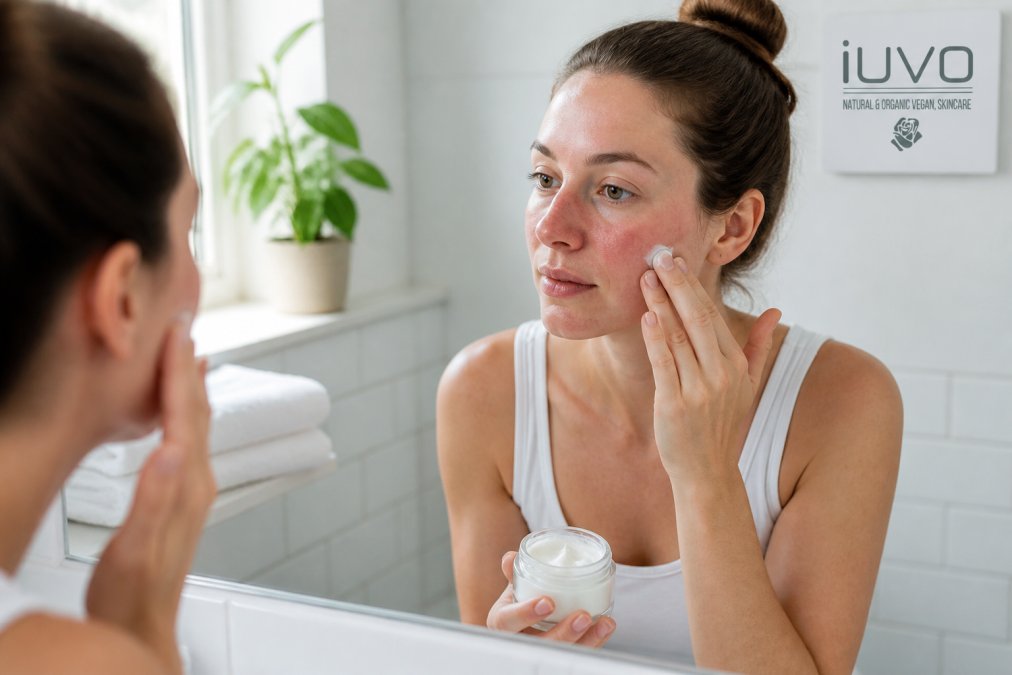
Step 1: Cleanse Without Stripping
Cleanse with lukewarm water and a gentle, pH-balanced cleanser, using fingertips rather than a cloth. Hot water and friction both strip the barrier. Pat dry rather than rubbing.

Step 2: Treat, But Only What the Barrier Needs
Serums go on after cleansing and before moisturiser, applied to damp skin. A hydrating serum with hyaluronic acid or glycerin suits most reactive skin types, because humectants draw water into the upper layers without adding oil load.
Step 3: Moisturise While Skin Is Still Damp
Moisturise within a minute of cleansing, while skin is still slightly damp. This traps water in the upper layers rather than sealing over dry skin, and it is the step most people get wrong.
Step 4: Protect
Protection means two things: a daily sunscreen, and a routine that does not undo itself overnight. Sun exposure worsens redness and post-inflammatory pigmentation on reactive skin, so a fragrance-free mineral or hybrid sunscreen is worth the effort of finding one that does not sting. At night, the same moisturiser applied slightly more generously can act as an occlusive layer while the barrier repairs.
Where Exfoliation Fits, and Where It Does Not
Exfoliation should be occasional, not daily. Once a week at most, using a gentle chemical exfoliant such as lactic acid rather than a physical scrub. If skin is actively inflamed, skip it entirely until the barrier recovers.
Transitioning from a Non-Vegan Routine Without a Flare-Up
Changing your whole routine at once gives you no way to identify which product caused a reaction if one appears, and it removes the familiar formulas your barrier has adapted to all at once.
A practical sequence:
- Week 1, swap the moisturiser. It stays on your skin longest, so it is the highest-impact change and the easiest to assess.
- Week 2, swap the cleanser. Cleansers have the most contact with the barrier, so give this change a full week before adding anything else.
- Week 3, swap the treatment or serum. Introduce it alone, on damp skin, and watch for delayed reactions over three days.
- Week 4, swap the toner or any remaining step. Toners have the least contact time, so they are the safest to change last.
- Keep one familiar product in place throughout the transition if your skin is very reactive. A single unchanged product gives you a baseline to compare against.
Choosing the Best Vegan Face Moisturiser for Sensitive Skin
The best vegan face moisturiser for sensitive skin is one with a short ingredient list, no added fragrance, and a combination of humectants and barrier-repairing lipids. Texture matters too: a rich butter suits dry, reactive skin, while a lighter lotion suits combination types.
Patch Testing Vegan Skincare Products Before You Commit
Patch testing vegan skincare products before you commit means applying a small amount to a discreet area and waiting before using it on your face. Vegan and natural formulas can still cause reactions, so the label does not guarantee your own skin's response.
A 72-Hour Patch Test Protocol
- Day 1, morning: apply a pea-sized amount behind your ear or on your inner forearm
- Day 1, evening: check for redness, itching or swelling. If any appear, stop
- Day 2: leave the area alone and check again for a delayed reaction
- Day 3: if the area is clear, apply a small amount to your jawline
- Day 4: if still clear, begin using the product as intended
- Note the batch number and date in case of a later reaction
Delayed reactions are a reason a 24-hour test may not be enough. Contact dermatitis can take up to 72 hours to appear, so testing over three days can catch what a single day misses.
Building a Full Routine: What It Costs
A complete vegan routine for sensitive skin does not need to be expensive. The core four steps, cleanser, toner, moisturiser and treatment, cover almost everything reactive skin needs.
Product |
Size |
Price |
Role in Routine |
|---|---|---|---|
Rose Geranium Face Wash |
50ml |
£8.00 |
Gentle daily cleanse |
Balancing White Lotus Toner |
50ml |
£8.00 |
Calm and rebalance after cleansing |
Deep Hydrating Unscented Butter |
30g |
£9.00 |
Moisturise and seal in hydration |
Soothing Unscented Face & Body Soap |
85g |
£4.00 |
Fragrance-free cleansing alternative |
Transitioning to Vegan Skincare Without a Flare-Up
Transitioning to vegan skincare without a flare-up means changing one product at a time, not your whole routine at once. A full swap gives you no way to identify which product caused a reaction if one appears.

The Environmental Impact of Plant-Based Ingredients
The environmental impact of plant-based ingredients varies enormously, and "plant-based" is not automatically the greener choice. Palm oil, for example, is plant-derived but linked to deforestation when not sourced responsibly. Iuvo Skincare excludes it entirely.
Common Bad Advice About Vegan Skincare for Sensitive Skin
Common bad advice about vegan skincare for sensitive skin can come down to three myths: that natural means gentle, that vegan means hypoallergenic, and that sensitive skin needs fewer products.
Frequently Asked Questions
Is vegan skincare always better for sensitive skin?
Not automatically. Vegan means no animal-derived ingredients, but a plant-based formula can still contain essential oils, fragrance or botanical extracts that trigger reactions. What matters more is whether the product is fragrance-free, pH-balanced and free from known irritants like sulphates and parabens. Look for short ingredient lists, dermatologically-tested claims and unscented options such as the Soothing Unscented Face & Body Soaps (£4.00 for 85g), which are made with no essential oil for eczema and psoriasis-prone skin.
What is a good vegan face moisturiser for sensitive skin?
A good one hydrates without occluding pores or adding fragrance. Look for plant butters and carrier oils that support the lipid barrier, such as coconut, jojoba and rosehip oils, plus soothing additions like neem. The NOURISH Award Winning Deep Hydrating Unscented Face & Body Butters (£9.00) combine those oils and are unscented, which suits reactive and eczema-prone skin. Avoid anything with added perfume or essential oils if your skin flares easily.
How do I patch testing vegan skincare products properly?
Apply a small amount to the inner forearm or behind the ear, then leave it for 24 hours without washing the area. If there is no redness, itching or swelling, repeat on a small patch of facial skin for another 48 hours. Stop immediately if you notice a reaction. Keep the product sealed and note the batch in case you need to compare. Patch testing vegan skincare products takes three days, but it prevents a full-face flare-up from a single ingredient.
What ingredients should I avoid if I have sensitive skin?
Common triggers include synthetic fragrance, essential oils such as citrus and peppermint, sulphates like SLS, parabens, drying alcohols and physical scrubs with rough particles. Baking soda in deodorants is another frequent cause of underarm irritation. If you have rosacea or eczema, keep exfoliation gentle and infrequent, and choose pH-balanced, fragrance-free formulas. Checking for 'essential oil-free' and 'non-comedogenic' on the label saves a lot of trial and error.
How can I tell if a skincare product is truly vegan?
Look for a recognised vegan certification logo on the packaging, not just a 'plant-based' claim. Vegan certification means no animal-derived ingredients such as beeswax, lanolin, honey or carmine, and it usually sits alongside a cruelty-free statement. Iuvo Skincare's range is 100% vegan certified and cruelty-free, with no animal testing. If a brand cannot point to a specific certifying body, treat the claim with caution.
Which botanical ingredients soothe sensitive skin best?
Calendula, aloe vera, chamomile, oat and rose geranium are among the most reliable soothing botanicals. Rose geranium in particular is used in gentle cleansers to calm reactive skin while lifting debris. Iuvo's Sensitive Face Wash with Rose Geranium (£8.00 for 150ml) is built around that idea, and the Balancing Toner with White Lotus (£8.00) helps calm skin after cleansing. Introduce one botanical at a time so you can identify what your skin tolerates.
How much does a full vegan sensitive skin routine cost?
At Iuvo Skincare a simple four-step routine comes to £33: the Sensitive Face Wash with Rose Geranium (£8.00), the Balancing Toner with White Lotus (£8.00), the Gentle Facial Cleansing Lotion with Linden Blossom (£8.00) and the Deep Hydrating Unscented Face & Body Butters (£9.00). That covers cleansing, toning and moisturising. Adding the unscented soaps at £4.00 for 85g keeps the total under £37.
Can I use vegan skincare during cancer treatment?
Many people undergoing treatment need fragrance-free, essential oil-free and sulphate-free products because skin becomes fragile and reactive. Iuvo's unscented range is formulated without parabens, sulphates, palm oil or added fragrance, which reduces the number of potential irritants. Always check with your oncology team before introducing anything new, and patch test first. A short, simple routine with fewer ingredients is usually easier on compromised skin than a multi-step regime.
Sensitive skin rarely needs more products. It needs fewer, better ones, chosen with the barrier in mind rather than the label. Iuvo Skincare makes handmade, vegan-certified formulas free from parabens, sulphates and palm oil, with unscented options built for reactive skin and a full core routine for under £30. Search our store to find the cleanser, toner and butter that suit your skin, and start with one product at a time.


