
Natural Deodorant for Sensitive Skin: 2026 Guide
by Ian Gabbidon on Sep 17, 2026

Table of Contents
- Why Baking Soda Causes Irritation in Natural Deodorant
- Baking Soda Free Deodorant: What to Look For
- How to Transition to Natural Deodorant Without Irritation
- Natural Deodorant Rash Treatment: Steps for Relief
- Fragrance-Free vs Essential Oil-Free Options
- Understanding the Detox Phase and Persistent Odour
- Conclusion: Choosing Gentle Freshness
- Frequently Asked Questions
Last Updated: September 17, 2026
Why Baking Soda Causes Irritation in Natural Deodorant
Sodium bicarbonate, the same compound in your kitchen cupboard, is the single most common cause of underarm irritation from natural deodorant. It works by neutralising odour-causing bacteria, but it also disrupts the skin's natural acid mantle, and for anyone with sensitive skin that disruption shows up fast as redness, itching, and burning.
How Sodium Bicarbonate Affects the Skin Barrier
Your underarm skin is thinner and more folded than almost anywhere else on your body, which makes it more vulnerable to irritants. Sodium bicarbonate is alkaline, with a pH around 8.3, while healthy skin sits at roughly 4.5 to 5.5. Applying an alkaline powder daily pushes that balance upward.
Baking Soda Free Deodorant: What to Look For
A baking soda free deodorant swaps sodium bicarbonate for gentler odour control: magnesium hydroxide, zinc ricinoleate, or naturally antibacterial plant extracts. These raise the pH far less and let the skin barrier recover.
Look for these on the label:
- Magnesium hydroxide for odour neutralising without alkalinity
- Arrowroot powder or tapioca starch for sweat absorption
- Shea or cocoa butter as moisturising agents
- pH-balanced formulas close to skin's natural acidity
- Dermatologically tested and hypoallergenic claims
Key Ingredients That Soothe Sensitive Underarms
Soothing ingredients matter as much as the absence of bicarb. Aloe vera, oat extract, and calendula calm reactive skin, while glycerin and raw butters pull moisture back into a stressed barrier. Probiotic and prebiotic additions support the skin microbiome, the community of bacteria that naturally keeps odour in check.
Ingredient Type |
What It Does |
Best For |
|---|---|---|
Magnesium hydroxide |
Neutralises odour |
Everyday freshness |
Arrowroot powder |
Absorbs moisture |
Sweat absorption |
Shea butter |
Repairs barrier |
Dry, flaky skin |
Aloe vera |
Calms redness |
Reactive underarms |
Prebiotics |
Supports microbiome |
Persistent odour |
How to Transition to Natural Deodorant Without Irritation
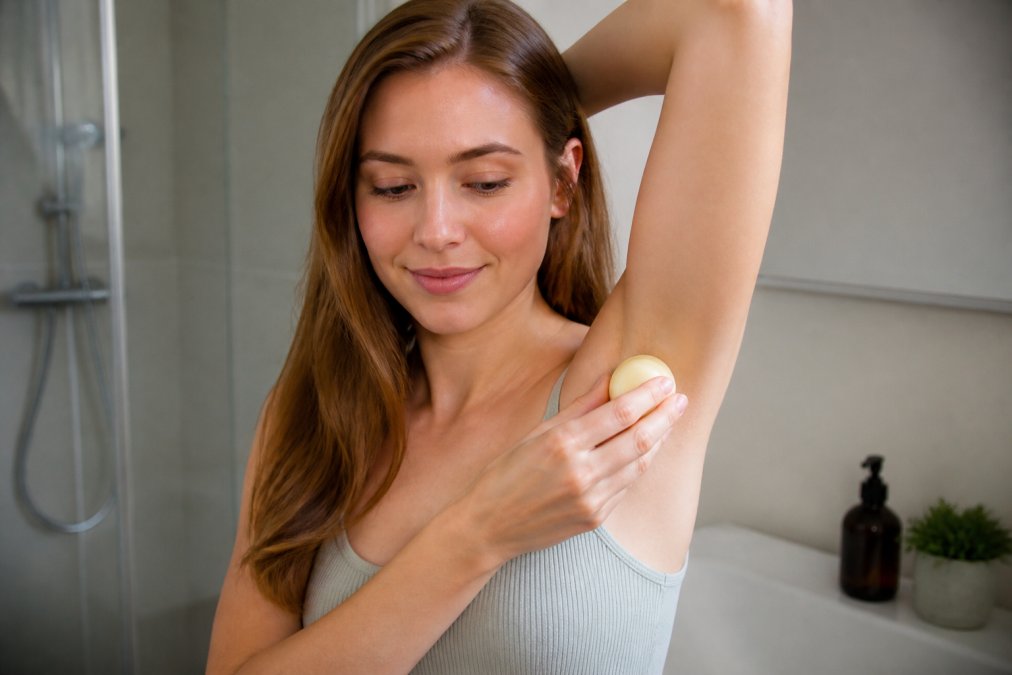
Transitioning is not about willpower, it is about giving the underarm skin barrier and its resident bacteria time to rebalance. Most people need roughly two to four weeks, not the one to two weeks often quoted, and the first ten days are usually the worst. Going cold turkey from an antiperspirant is the single most common mistake, because you are changing two variables at once: the product on the skin and the bacterial population underneath it.
Why the First Fortnight Feels Worse
Antiperspirants work by plugging sweat ducts with aluminium salts, which temporarily reduces how much sweat reaches the surface. When you stop, sweat output returns to its natural baseline and the underarm microbiome, the community of bacteria living on the skin, shifts in response. Odour-causing species such as Corynebacterium can briefly flourish before the skin's acid mantle and a well-formulated natural deodorant bring them back into balance.
A Four-Week Staged Routine
- Days 1-3: Apply natural deodorant in the morning and reapply once mid-afternoon if needed. Keep your old antiperspirant on the shelf for emergencies only.
- Days 4-10: Switch fully to natural deodorant. Expect stronger odour than usual, this is normal and temporary. Wash underarms with a gentle, soap-free cleanser at night to remove product residue and dead skin cells.
- Days 11-21: Odour should begin to settle. If it has not, check your application: applying to damp skin dilutes the formula and reduces its efficacy. Pat dry first.
- Days 22-28: Most people reach a stable baseline here. If odour is still persistent, the formula may be too weak for your activity level rather than a transition problem, see the troubleshooting guidance below.
Post-Shave Application Protocol
This is the step most guides skip, and it is where sensitive skin flares most often. Shaving removes the top layer of dead cells and leaves micro-abrasions on skin that is already thin and folded. Applying deodorant immediately afterwards drives fragrance, essential oils and alkaline ingredients straight into compromised tissue.
- Shave at night, not in the morning. This gives the skin six to eight hours to begin repairing before product goes on.
- Wait at least 12 hours after shaving before applying any deodorant, natural or otherwise.
- Use a fresh, sharp razor and shave with the grain. A blunt blade drags and causes more micro-damage.
- Skip the post-shave balm if it contains fragrance or essential oils, a plain, fragrance-free emollient is safer.
- If you must apply deodorant the same day, choose an essential oil-free balm and use a thinner layer than usual.
Patch Testing That Actually Works
A 48-hour patch test on the inner forearm is a reasonable starting point, but the underarm is a different environment: warmer, damper, more folded and subject to friction. For a more accurate result, patch test on a small area of the underarm itself, on a day when you are not shaving, and wait 24 hours before applying to the full area.
When Transition Is Not the Problem
If irritation appears rather than odour, redness, itching, burning within minutes of application, stop using the product. That is not a detox phase; it is contact irritation, and continuing will make it worse. Transition discomfort is about smell. Transition irritation is about skin, and it needs a different response.
Natural Deodorant Rash Treatment: Steps for Relief
Stop using the product, then treat the skin like any irritated area: cool water, a fragrance-free emollient, and no shaving until it settles. Most mild reactions calm within a few days once the irritant is removed.
Steps for relief:
- Wash with lukewarm water and a scent-free cleanser
- Apply a thick, fragrance-free moisturiser or barrier cream
- Wear loose cotton clothing to reduce friction
- Avoid essential oils and synthetic fragrance until healed
- If it spreads, blisters, or lasts beyond a week, speak to a pharmacist
Fragrance-Free vs Essential Oil-Free Options
Fragrance-free and essential oil-free are not the same claim, and the gap between them is where most sensitive-skin reactions hide. A fragrance-free deodorant contains no added perfume or parfum, but it can still include essential oils such as lavender, tea tree, geraniol, limonene or linalool, all of which are recognised skin sensitisers and all of which must be declared on the label under UK cosmetic labelling rules.
Why 'Natural' Fragrance Is Not Automatically Gentler
Essential oils are concentrated plant extracts containing dozens of individual chemical compounds. Some of those compounds, limonene and linalool in particular, oxidise on exposure to air and become more sensitising over time. A product that was fine when you opened it can provoke a reaction three months later. This is one reason a deodorant you previously tolerated suddenly starts to sting.
Reading the Label Like an Editor
- 'Parfum' or 'Fragrance', a catch-all term that can cover hundreds of ingredients, including essential oils.
- 'Fragrance-free', no added perfume, but essential oils may still be present.
- 'Essential oil-free', no plant aromatic oils, though the formula may still contain botanical butters or extracts that are not aromatic.
- 'Unscented', a marketing term with no fixed legal definition; treat it with caution.
- Named sensitisers, limonene, linalool, citronellol, geraniol, eugenol and citral must be listed individually when they exceed set thresholds in a leave-on product.
The Microbiome Angle Most Guides Miss
Removing fragrance and essential oils is only half the picture. A truly sensitive-skin formula should also support the underarm microbiome rather than simply stripping it. Antibacterial actives, including some 'natural' ones like tea tree and high-concentration coconut derivatives, can wipe out the beneficial bacteria that keep odour-causing species in check, leaving the skin more vulnerable over time.
Patch Testing to Separate the Two
If you are unsure whether fragrance or essential oils are your trigger, test them separately. Apply a fragrance-free but essential-oil-containing product to one underarm and a fully essential oil-free product to the other, on a day you are not shaving. Wait 48 hours. If only one side reacts, you have your answer, and you can shop accordingly rather than avoiding every 'natural' product on the shelf.
Understanding the Detox Phase and Persistent Odour
The detox phase is the adjustment period when your underarms shift from antiperspirant to natural deodorant. It can bring temporary extra odour as the skin microbiome rebalances, typically lasting one to two weeks.
- Not enough odour control: the formula may be too weak for your activity level
- Application timing: applying to damp skin dilutes the product
- Bacterial build-up: dead skin and bacteria need gentle exfoliation
Conclusion: Choosing Gentle Freshness
Finding a natural deodorant for sensitive skin comes down to one thing: removing the ingredient that irritates, not abandoning natural formulas altogether. Baking soda free, fragrance-free, and microbiome-friendly options let you stay fresh without the burn.
Frequently Asked Questions
What deodorant should I use if I have sensitive armpits?
Look for a natural deodorant for sensitive skin that is baking soda free, fragrance-free, and aluminium-free. Avoid synthetic fragrance and essential oils if you have reactive skin. Patch testing on a small area before full application helps identify any triggers. Iuvo Skincare offers gentle, handmade options free from common irritants.
Why does natural deodorant cause a rash?
Natural deodorant rash often stems from baking soda (sodium bicarbonate), which raises skin pH and disrupts the skin barrier. Essential oils and synthetic fragrances can also trigger contact dermatitis. The detox phase, where underarm bacteria adjust, may cause temporary irritation. Switching to a baking soda free deodorant with soothing ingredients like aloe vera or oats can prevent further flare-ups. If a rash persists, stop use and consult a dermatologist.
How do I transition to natural deodorant without irritation?
Transition gradually over two to four weeks. Start by applying your natural deodorant every other day while still using your old product on alternate days. This helps your skin microbiome adjust. Keep underarms clean and dry, and avoid shaving immediately before application. If irritation occurs, pause and treat with a gentle rash cream. Choose a formula with moisturizing agents like raw butters to support the skin barrier during the switch.
What is the best natural deodorant rash treatment?
For a natural deodorant rash, stop using the product immediately. Clean the area with lukewarm water and a mild, fragrance-free cleanser. Apply a soothing balm containing ingredients like colloidal oatmeal, calendula, or shea butter. Avoid scratching and let the skin breathe. If the rash doesn't improve in a few days, see a pharmacist or dermatologist. Switching to a hypoallergenic, baking soda free deodorant after healing can prevent recurrence.


